
Missing teeth can affect how you eat, speak, and feel about your smile. When you’re considering dental implants, you might wonder about the smaller option called mini implants.
Mini implants are generally safe and effective for many patients, particularly those with limited bone density or who need to stabilize dentures, though they may not offer the same long-term durability as traditional implants in all situations.
Mini dental implants are smaller alternatives measuring less than 3 millimeters in diameter, compared to traditional implants, which range from 3.5 to 6 millimeters.
They work well for specific cases and cost less than full-sized implants. Understanding the safety profile and proper use of mini implants helps you make a smart choice for your dental health.
The decision between mini dental implants vs traditional implants depends on your specific needs, bone health, and budget.
This article breaks down the safety concerns, candidacy requirements, and practical differences so you can work with your dentist to pick the right option.
Key Takeaways
- Mini implants are safe for appropriate candidates but have different durability expectations than traditional implants
- They cost between $500 and $1,500 per implant compared to $1,500 to $6,000 for traditional implants
- Your bone density, tooth location, and long-term goals determine which implant type works best for you
What Are Mini Implants and Traditional Implants?
Both mini dental implants and traditional dental implants replace missing teeth by anchoring into your jawbone.
Mini implants measure less than 3mm in diameter, while traditional dental implants are much wider at 3.25 to 5 millimeters across.
Key Differences in Design and Structure
The biggest difference between mini and traditional implants is their physical design. Traditional implants come in two separate pieces.
The first piece is a post that goes into your jawbone, and the second is an abutment that connects the post to your replacement tooth.
Mini implants work differently. They’re built as one solid piece with a ball-shaped end that sticks out from your gum. This simpler design makes them easier to place but limits what they can do.
The size comparison breaks down like this:
- Mini implants: Less than 3mm wide, one-piece design
- Traditional implants: 3.25-5.8mm wide, two-piece design
- Length: Both types are roughly the same length
Your jawbone density matters more with traditional implants. They need enough healthy bone to support their larger size.
Mini implants need less bone because they’re smaller, which means you might avoid bone grafting procedures.
Types of Tooth Replacement Each Supports
Mini implants work best for stabilizing dentures and replacing smaller front teeth. You’ll typically need 4-6 mini implants to secure a denture.
They don’t handle heavy chewing forces well, so dentists rarely use them for back teeth.
Traditional dental implants can replace any tooth in your mouth. They’re strong enough for molars that handle up to 200 pounds of bite force. You can use them for single tooth replacement, bridges, or full-arch restorations.
Your dentist might suggest mini implants if you have bone loss or want denture stability. Traditional implants are better for long-term durability when replacing teeth in areas with high bite pressure.
Safety and Effectiveness of Mini Implants
Mini implants use the same biocompatible materials as traditional implants and integrate with your jawbone through osseointegration.
They typically last about half as long as conventional implants but offer a less invasive placement procedure with fewer complications for suitable candidates.
Osseointegration and Longevity
Mini implants bond with your jawbone through osseointegration, the same biological process that traditional implants use.
The titanium material fuses with your bone tissue over time, creating a stable foundation for your replacement teeth.
Your mini implants will heal faster than standard implants because they require less surgical trauma. The smaller diameter of mini implants (less than 3 mm) means less bone disruption during placement.
However, you should know that mini implants generally have a shorter lifespan. They typically last about half as long as traditional implants, which can function for 20 years or more with proper care.
The reduced diameter means less surface area for bone integration, which can affect long-term stability.
Stability and Performance Compared to Traditional Implants
Your mini implants work well for stabilizing dentures and replacing small teeth like lower incisors. They perform best in areas with lower bite forces.
Traditional implants offer greater stability for replacing molars and other teeth that handle heavy chewing pressure. The wider diameter of conventional implants provides more support for load-bearing teeth.
Key Performance Differences:
- Bite force tolerance: Mini implants handle less pressure
- Bone support: Traditional implants distribute forces better
- Application: Mini implants excel for denture stabilization
Your oral health plays a big role in how well either type performs. You need adequate bone density, though mini implants require less bone volume than traditional options.
Curious which implant is right for you? Visit My Harmony Smiles in Ocala, Palm Harbor, Trinity, Brooksville, or Oldsmar to explore mini dental implants vs traditional implants with our experts.
Complications and Risks
You face similar but generally fewer complications with mini implants compared to traditional ones. The less-invasive dental mini-implant procedure reduces your risk of infection and post-operative complications.
Common risks include:
- Implant loosening or failure
- Infection at the implant site
- Peri-implantitis (inflammation around the implant)
- Bone loss over time
Your risk of peri-implantitis exists with both implant types, but proper oral hygiene significantly reduces this concern. Mini implants may fail more often in high-stress applications, such as molar replacement.
You’ll have better outcomes when your dentist selects the right implant type for your specific situation. Mini implants are safe and effective in appropriate cases, but aren’t ideal for every dental implant procedure.
Candidacy and Clinical Considerations
Not everyone qualifies for mini dental implants, and your bone density, overall health, and specific dental needs all play a role in determining whether they’re right for you.
Understanding these factors helps you make an informed decision about your treatment options.
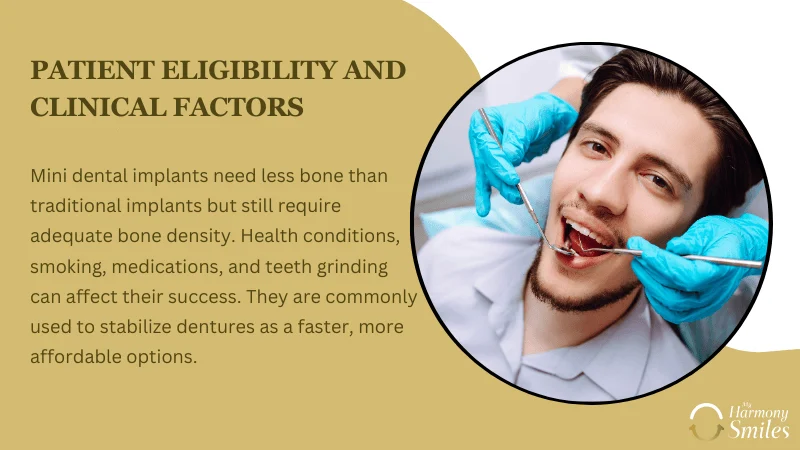
Bone Density and Bone Grafting Needs
Your jawbone density is one of the most important factors to consider when choosing mini dental implants.
Mini dental implants (MDIs) are smaller than traditional implants, measuring between 1.8 and 3 millimeters in diameter. This smaller size means they need less bone to anchor properly.
If you’ve experienced bone loss after losing teeth, you might still qualify for mini implants when traditional implants aren’t an option.
The compact design lets dentists place them in areas with limited bone mass. This often eliminates the need for bone grafting procedures.
Traditional implants usually require a bone graft if you don’t have enough jawbone density. A bone graft adds time and cost to your treatment. Mini implants help you avoid this extra step in many cases.
However, you need a minimum bone density for mini implants to work. If you have severe bone loss, your dentist might recommend other options.
Your dentist will take X-rays or CT scans to assess your jawbone and determine whether mini implants will remain secure.
Health and Lifestyle Factors
Your overall health affects whether mini implants will work for you. Certain medical conditions can slow healing or prevent the implant from bonding properly to your jawbone.
If you have uncontrolled diabetes, you might face higher risks of implant failure. Your blood sugar levels need to be managed before getting mini implants.
Smoking also reduces success rates because it limits blood flow to your gums and jawbone.
You should discuss any medications you’re taking with your dentist. Blood thinners, bisphosphonates, and some other drugs can affect healing. Your dentist needs this information to plan your treatment safely.
Mini implants are best for replacing smaller teeth, such as incisors and premolars.
If you grind your teeth at night, the extra pressure might damage mini implants over time. Your dentist may suggest wearing a nightguard to protect them.
Suitability for Stabilizing Dentures
Mini implants are highly effective for stabilizing dentures and securing them in place. If you currently wear removable dentures that slip or feel uncomfortable, mini implants can make a significant difference.
Your dentist typically places four to six mini implants along your jawbone to hold your dentures steady. The dentures snap onto the implants, which keep them from moving when you eat or talk.
This gives you more confidence than traditional removable dentures.
The procedure for denture stabilization is usually quick. Many patients can have their mini implants placed and start using them the same day.
You don’t need the extensive healing time that traditional implant-supported dentures require.
Mini implants cost less than traditional implants for denture stabilization. You’ll spend between $500 and $1,500 per implant compared to $1,500 to $6,000 for regular implants.
This makes them a budget-friendly choice for securing your dentures.
Benefits and Limitations of Mini Implants
Mini dental implants offer distinct advantages, such as simpler procedures and quicker healing times, but they also come with important trade-offs in terms of strength and longevity, which affect their suitability for replacing missing teeth.
Minimally Invasive Procedures
One of the biggest advantages of mini dental implants is their simpler placement process. Your dentist can often place them without cutting and lifting your gum tissue.
This means no stitches and less bleeding during the procedure.
The smaller diameter of mini implants allows them to fit in areas with less bone width. You typically won’t need bone grafting procedures that traditional implants often require.
This makes the mini dental implant procedure much less complex.
Your dentist can usually complete the entire placement in a single appointment. The process involves making a small pilot hole and screwing the implant directly into your jawbone.
This straightforward approach reduces both the time in the dental chair and the overall cost of your dental restoration.
Faster Recovery and Immediate Loading
You’ll experience much less discomfort after getting mini implants compared to traditional ones. Most patients report minimal pain and swelling. You can return to your normal activities within a day or two.
The healing time is significantly shorter because the procedure is less invasive. Your dentist can often attach a temporary crown or denture on the same day as placement.
This immediate loading means you won’t have to wait months to use your new teeth.
The reduced recovery period also means fewer follow-up appointments. You’ll save time and money while getting back to eating and speaking normally, much faster than with traditional implants.
Have questions about mini implants or traditional implants? Contact us today to discuss your options and get personalized guidance for your smile.
Restrictions on Use and Durability
Mini implants have important limitations you should understand before choosing them. They typically last about half as long as traditional implants due to their smaller size and reduced stability.
Your dentist may not recommend mini implants for replacing missing teeth in the back of your mouth. Molars handle heavy chewing forces that can cause mini-implants to fail.
They’re less stable than standard implants and are more prone to breaking under pressure.
Best uses for mini implants include:
- Securing lower dentures
- Replacing front teeth with lighter bite forces
- Temporary solutions while waiting for bone healing
- Patients with thin jawbones who cannot undergo bone grafting
The thinner structure means they can’t support the same amount of force as traditional implants. You’ll need to be more careful about what you eat and how you chew to protect your investment.
Cost Comparison and Financial Considerations
Mini dental implants typically cost $500 to $1,500 per implant, while traditional implants range from $3,000 to $6,000 per tooth.
Understanding these price differences and insurance coverage helps you make an informed financial decision for your dental health.
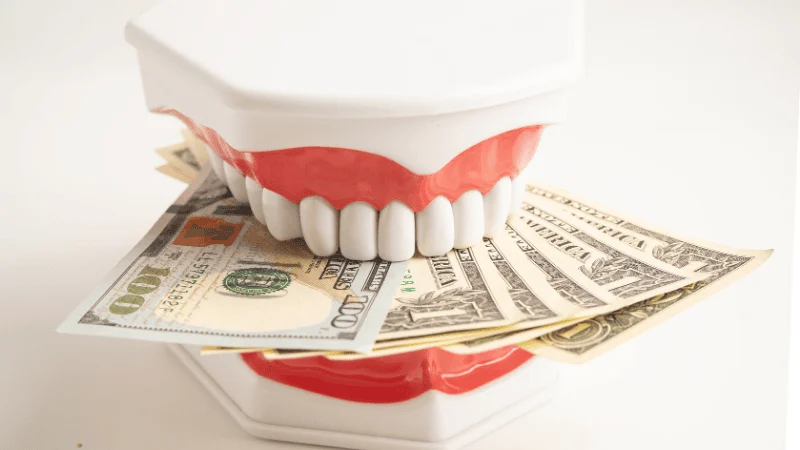
Cost Factors for Mini and Traditional Implants
The cost of mini dental implants is significantly lower because the procedure is less complex and requires fewer materials.
Traditional implants require a larger titanium post, an abutment, and often bone grafting, which adds to the total expense.
Mini implants use a smaller, one-piece design that reduces surgical time and complexity. You’ll save money on the initial procedure since it often requires no incisions or stitches.
The dental implant cost also depends on your location and the dentist’s experience. Urban areas typically charge more than rural locations.
Your specific treatment plan affects the final price, including how many implants you need and whether you require additional procedures like extractions or bone grafting.
Insurance and Long-Term Value
Dental insurance may cover a portion of your implant costs, though coverage varies widely between plans. You should check with your insurance provider before treatment to understand what’s included in your policy.
Traditional implants can last 20 years or more with proper care, while mini implants may last 7 to 15 years. This difference affects long-term value
Although traditional implants have higher upfront costs, their longer lifespan might make them more cost-effective over time.
Mini implants may need more frequent maintenance and adjustments. You might face additional costs for repairs or replacements sooner than with traditional implants.
Consider both the initial investment and potential future expenses when deciding which option fits your budget and dental needs.
Choosing the Best Dental Implant Option for You
Your dentist will evaluate your bone structure, health history, and budget to recommend the right implant type.
The decision between mini and traditional implants depends on your specific needs and long-term goals for your smile.
Consulting with Your Dentist
Your dentist will use advanced imaging to assess your jawbone density and overall oral health before recommending an implant option.
This evaluation helps determine if you have enough bone to support traditional implants or if mini implants would work better for your situation.
During your consultation, your dentist will ask about your medical history. Conditions like diabetes, bone disease, or immune disorders can affect which implant type is safest for you.
They’ll also check if you take medications that could impact healing or bone integration.
Your dentist will discuss the location of your missing teeth. Traditional implants work better for back teeth that handle heavy chewing forces. Mini implants are often recommended for front teeth or to stabilize dentures.
Cost is another important topic to cover with your dentist.
Traditional implants cost between $3,000 to $6,000 per tooth, while mini implants range from $500 to $1,500. Your dentist can help you understand the long-term value of each option.
Personalizing Your Tooth Replacement Plan
Your tooth replacement plan should match your lifestyle, timeline, and dental restoration needs. If you need to replace missing teeth quickly, mini implants can be loaded with crowns or dentures right away.
Traditional implants require 3-6 months of healing before you can get your permanent teeth.
Think about how long you want your dental implants to last. Traditional implants can function for 25 years or longer with proper care. Mini implants typically last 10-15 years before needing replacement.
Your daily habits matter when choosing between dental implant options.
If you grind your teeth or play contact sports, traditional implants offer more stability. Mini implants work well if you want a less invasive procedure with faster recovery.
Ridge Oral Surgery offers personalized consultations to help you determine which option fits your smile goals.
Your dentist will create a treatment plan that considers your bone structure, the number of teeth you need to replace, and your budget for achieving better oral health.
Start your journey to a secure, confident smile. Fill out our new patient form online to schedule a consultation and determine the best implant type for you.
Frequently Asked Questions
Mini implants raise common questions about their benefits, suitability, recovery periods, and long-term performance. Understanding these aspects helps you make an informed choice about your dental treatment.
What are the advantages of choosing mini implants over traditional dental implants?
Mini implants offer several key benefits that make them attractive for many patients. The procedure is less invasive because the smaller post requires less drilling and often no incisions or stitches.
You’ll typically pay less for mini implants, with costs ranging from $500 to $1,500 per implant compared to $1,500 to $6,000 for traditional implants.
The treatment time is faster too, often completed in a single visit instead of requiring multiple appointments over several months.
Recovery tends to be quicker and less painful. If you have low bone density, mini implants can be used in areas where traditional implants might not be suitable, often eliminating the need for bone grafting.
Can mini implants be used for any patient, or are there specific requirements?
Mini implants aren’t right for everyone. They work best for patients with limited bone density or smaller gaps in their smile.
You might not be a good candidate if you have extensive bone loss or need to replace larger teeth like molars.
Mini implants are typically used to replace smaller teeth, such as incisors and premolars, or to secure dentures in place.
Patients who grind their teeth or have other dental issues that put significant strain on implants may also need to consider traditional implants instead.
Your dentist will assess your specific situation to determine if mini implants are suitable for your needs.
What is the typical recovery time after getting mini implants?
Recovery from mini implants is generally faster than traditional implants. Because the procedure is minimally invasive, most patients experience minimal downtime.
You can often use your mini implants much sooner than traditional implants.
While traditional implants require several months for the bone to integrate before attaching a crown or bridge, mini implants are typically ready for use in a much shorter time frame.
Most patients return to normal activities quickly. The lack of incisions and stitches means less pain and swelling during the healing process.
How long do mini dental implants last compared to traditional ones?
Mini dental implants generally have a shorter lifespan than traditional implants. Some dental professionals have raised concerns about their long-term durability because of their smaller size.
The smaller design may make them more prone to wear and tear over time. Typically, mini dental implants last about half as long as traditional implants.
Traditional implants are larger and more durable, making them better suited for long-term use. However, with proper care and maintenance, mini implants can still provide lasting results for many years.
Are there any specific care instructions for mini implants after the procedure?
You need to maintain good oral hygiene to keep your mini implants in good condition. Brush twice daily with a soft-bristled toothbrush and fluoride toothpaste, being gentle around the implant area.
Floss regularly and consider using a water flosser to clean around the implants. This is especially helpful if your mini implants are supporting dentures or bridges.
Visit your dentist regularly for check-ups and professional cleanings. Avoid chewing hard foods, and don’t use your teeth as tools to open packages or bottles.
If you grind your teeth at night, ask your dentist about wearing a nightguard to protect your implants.
What potential risks or complications should be considered with mini implants?
Mini implants can sometimes require more frequent maintenance and check-ups than traditional implants. Because they’re smaller, they may be more susceptible to issues like loosening over time.
The crowns or dentures attached to them may need adjustments as time goes on. You should watch for signs of problems such as discomfort, looseness, or changes in how your implant feels.
Pain, swelling, or difficulty chewing are warning signs that need immediate attention from your dentist.
The smaller size also means mini implants may not provide the same stability and support as traditional implants in more complex situations.