
Are you unhappy with the way your teeth look?
Do you have chipped, discolored, or misshapen teeth that make you hide your smile?
You are not alone. Millions of people consider cosmetic dental treatments every year to improve their appearance and confidence.
Two of the most popular options are veneers and crowns. But how do you know which one is right for you?
Understanding veneers vs crowns can be confusing. Both treatments can transform your smile, but they serve different purposes, require different procedures, and offer different benefits.
This complete guide will explain everything you need to know about veneers vs crowns, their pros and cons, costs, durability, and which option is better for your specific dental needs. By the end, you will feel confident discussing your options with your dentist.
What Are Dental Veneers?
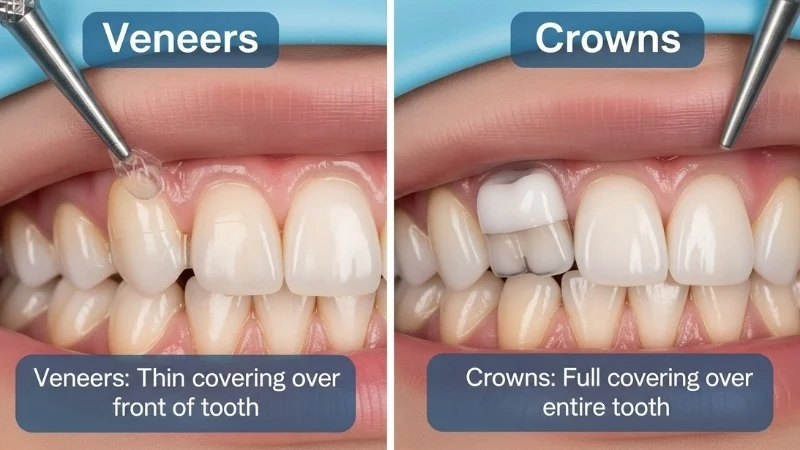
Dental veneers are thin, custom-made shells designed to cover the front surface of your teeth. They are like a false fingernail that fits over your natural tooth to improve its appearance.
Veneers are primarily a cosmetic solution, ideal for teeth that are otherwise healthy but have aesthetic issues.
Types of Veneers
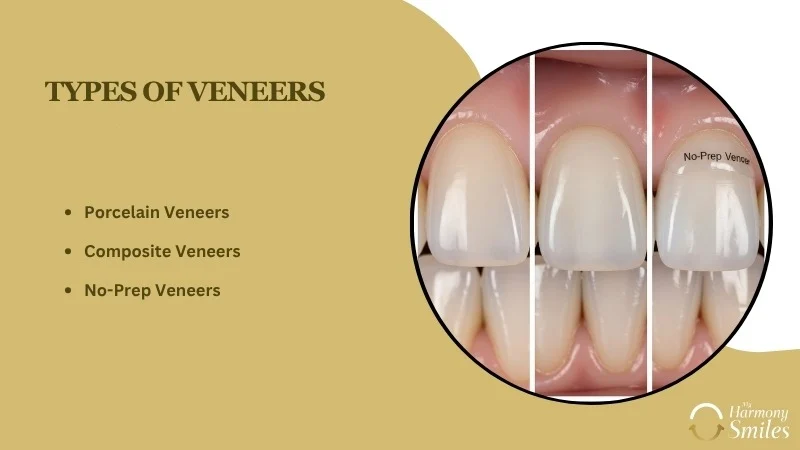
- Porcelain Veneers: These are the most popular and durable option. Made from high-quality ceramic, porcelain veneers resist stains and reflect light just like natural tooth enamel. They typically last 10 to 15 years with proper care.
- Composite Veneers: Made from tooth-colored resin material, composite veneers are less expensive but also less durable. They usually last 5 to 7 years and are more prone to staining and chipping.
- No-Prep Veneers: These ultra-thin veneers require little or no enamel removal. They are reversible in some cases but may not be suitable for all patients.
Benefits and Uses of Veneers
Following are the main uses and benefits of veneers:
- Cover stained or discolored teeth that do not respond to whitening
- Repair chipped or cracked teeth
- Close small gaps between teeth
- Reshape misshapen or slightly crooked teeth
- Create a uniform, natural-looking smile
What Are Dental Crowns?
Dental crowns are caps that cover the entire visible portion of a tooth, from the gum line up. Unlike veneers, which only cover the front, crowns encase the whole tooth.
Crowns serve both restorative and cosmetic purposes, protecting weak or damaged teeth while improving their appearance.
Types of Crowns

- Porcelain Crowns: These provide a natural, tooth-like appearance and are ideal for front teeth. They are less durable than metal crowns for back teeth.
- Metal Crowns: Made from gold, platinum, or base metal alloys. They are extremely durable and long-lasting but have a metallic color, making them better for molars that are not visible when you smile.
- Porcelain-Fused-to-Metal (PFM) Crowns: These combine the strength of metal with the appearance of porcelain. However, the metal core can sometimes show through as a dark line at the gum margin over time.
- All-Ceramic or Zirconia Crowns: These are strong, aesthetic, and biocompatible. Zirconia crowns are becoming increasingly popular for both front and back teeth.
Benefits and Uses of Crowns
Following are the main uses and benefits of crowns:
- Protect a weak tooth from breaking (often after a large filling or root canal)
- Restore a broken or severely worn tooth
- Hold a dental bridge in place
- Cover a dental implant
- Improve the appearance of a misshapen or severely discolored tooth
Veneers vs Crowns: Key Differences
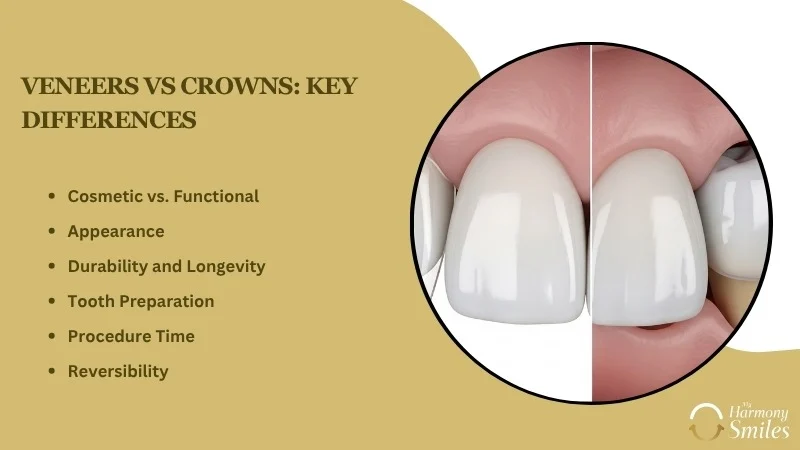
Understanding the core differences between veneers vs crowns which is better depends on your specific situation. Here are the most important distinctions.
- Cosmetic vs. Functional: Veneers are primarily cosmetic. They improve appearance but do not add significant strength to a tooth. Crowns are both cosmetic and functional. They restore and protect a tooth that is weak or damaged.
- Appearance: Veneers offer a more natural look because they only cover the front of the tooth and mimic the translucency of natural enamel. Crowns cover the entire tooth, which can sometimes look slightly bulkier, though modern all-ceramic crowns are very natural-looking.
- Durability and Longevity: When comparing veneers vs crowns which last longer, crowns generally have the edge. Porcelain crowns can last 15 to 20 years or more, while veneers typically last 10 to 15 years. However, both can last longer with excellent oral hygiene and regular dental care.
- Tooth Preparation: Veneers require minimal enamel removal, usually about 0.3 to 0.5 millimeters from the front surface. Crowns require more extensive tooth reduction, typically 1.5 to 2 millimeters around the entire circumference of the tooth.
- Procedure Time: Veneers usually require two to three visits. Crowns also require two visits, but the preparation is more invasive.
- Reversibility: Traditional veneers are irreversible because enamel is removed. Crowns are also irreversible. No-prep veneers may be reversible in some cases.
When to Choose Veneers
Veneers are the right choice when your teeth are generally healthy but you want to improve their appearance. Ideal candidates for veneers include people with:
- Teeth that are stained or discolored and do not respond to whitening treatments
- Small chips or cracks that do not affect the tooth’s structure
- Minor gaps between teeth (diastema)
- Slightly misshapen or uneven teeth
- Naturally small teeth that make your smile look gapped
Aesthetic Benefits: Veneers are excellent for creating a complete smile makeover. Because they only cover the front of your teeth, they look incredibly natural. Your dentist can customize the color, shape, and size to complement your face and achieve your desired smile.
Limitations: Veneers are not recommended for teeth with large cavities, significant decay, or insufficient enamel. They are also not ideal for people who grind or clench their teeth, as this can crack the veneers.
When to Choose Crowns
Crowns are the better option when a tooth needs protection or restoration in addition to cosmetic improvement. You should consider crowns if you have:
- A tooth that is severely decayed or has a large filling (more than half the tooth’s width)
- A tooth that is cracked, fractured, or weakened
- Undergone root canal therapy (crowns protect the now-brittle tooth)
- A tooth that is severely worn down from grinding or erosion
- A dental implant that needs a restoration
- A tooth that is misshapen or discolored in a way that veneers cannot fix
Restorative Benefits: Crowns provide full coverage and structural support. They hold the tooth together, prevent further damage, and allow you to bite and chew normally. For back teeth (molars and premolars) that endure heavy biting forces, crowns are almost always the better choice over veneers.
The Veneer Procedure: Step-by-Step
If you decide that veneers are right for you, here is what you can expect during the process.
- Consultation: Your dentist will examine your teeth, discuss your goals, and determine whether you are a good candidate for veneers. X-rays may be taken to check the health of your tooth roots and surrounding bone.
- Tooth Preparation: Your dentist will remove a very thin layer of enamel from the front surface of your teeth, about the thickness of a fingernail. Local anesthesia is often used to keep you comfortable.
- Impressions and Temporary Veneers: Digital impressions or traditional molds are taken of your prepared teeth. These are sent to a dental laboratory where your custom veneers will be fabricated. Temporary veneers are placed to protect your teeth while you wait, which usually takes 1 to 2 weeks.
- Final Placement: At your second visit, your dentist will remove the temporaries and try in your permanent veneers. The fit, color, and shape are checked. Once you and your dentist are happy, the veneers are bonded to your teeth with a special dental cement and hardened with a curing light. Final adjustments are made to ensure a comfortable bite.
Veneers and Natural-Looking Results
One of the biggest advantages of porcelain veneers is how natural they look. Natural-looking veneers are achievable because porcelain has similar light-reflecting properties to natural tooth enamel. Your dentist can customize:
- Color: Match the shade to your surrounding teeth or choose a brighter, whiter shade for a full smile makeover.
- Shape: Design teeth that complement your facial features, age, and gender.
- Size: Adjust proportions to create a harmonious, balanced smile.
With proper planning and an experienced cosmetic dentist, your veneers will be virtually indistinguishable from natural teeth.
Longevity and Maintenance of Veneers and Crowns
- Lifespan of Veneers: Porcelain veneers typically last 10 to 15 years. Composite veneers last 5 to 7 years. Factors that affect longevity include oral hygiene, dietary habits, teeth grinding, and regular dental checkups.
- Lifespan of Crowns: Crowns can last 10 to 20 years or even longer, depending on the material. Metal crowns are the most durable, while all-ceramic crowns are slightly less so but still very long-lasting.
Maintenance Tips for Both
- Brush twice daily with a non-abrasive toothpaste
- Floss daily, paying special attention to the margins where the restoration meets the tooth
- Avoid chewing ice, hard candy, or other hard objects
- Wear a nightguard if you grind your teeth
- Visit your dentist for regular checkups and cleanings
- Avoid using your teeth as tools to open packages
Cost Comparison: Veneers vs Crowns
When comparing veneers vs crowns price, both treatments represent significant investments in your smile. However, costs vary based on materials, the number of teeth treated, geographic location, and the dentist’s expertise.
- Veneers Cost: In the United States, porcelain veneers typically cost between $1,000 and $2,500 per tooth. Composite veneers are less expensive, ranging from $250 to $1,500 per tooth. Because veneers are considered cosmetic, dental insurance rarely covers them.
- Crowns Cost: Dental crowns typically cost between $1,000 and $3,500 per tooth, depending on the material. Porcelain-fused-to-metal crowns are usually at the lower end, while all-ceramic or zirconia crowns are at the higher end.
- Insurance Considerations: Crowns are often partially covered by dental insurance because they are considered restorative rather than purely cosmetic. Insurance may pay 50% to 80% of the cost of a crown needed to restore a decayed or damaged tooth. Veneers are rarely covered.
Are Veneers Reversible?
This is a common question. Are veneers reversible? For traditional porcelain or composite veneers, the answer is no. Because your dentist must remove a thin layer of enamel to create space for the veneer, the process is irreversible.
Once enamel is gone, it does not grow back. You will need to wear a veneer or crown on that tooth for the rest of your life.
No-prep veneers, also called minimal-preparation veneers, require little to no enamel removal. In some cases, these may be reversible, meaning the veneer can be removed and your tooth will look nearly the same as before. However, even no-prep veneers involve some surface etching and bonding, so “reversible” is a relative term.
Before committing to veneers, understand that you are making a permanent change to your natural teeth. Discuss all options with your dentist.
Common Alternatives to Veneers and Crowns
If you are not sure whether veneers vs crowns vs bonding or other options are right for you, consider these alternatives.
- Dental Bonding: Bonding uses a tooth-colored resin material applied directly to your tooth, shaped, and hardened with a special light. It is less expensive than veneers or crowns and can be completed in one visit. However, bonding is less durable, more prone to staining, and typically lasts only 3 to 5 years. It is best for small chips, gaps, or discolorations.
- Teeth Whitening: If your only concern is discoloration, professional teeth whitening may be a simpler, less expensive solution. However, whitening does not address chips, cracks, gaps, or misshapen teeth.
- Clear Aligners (Invisalign): If misalignment is your main issue, clear aligners can straighten your teeth without any enamel removal. After alignment, you may still want veneers or bonding for shape or color improvements.
Which Treatment Is Right for You?
Deciding between veneers vs crowns which is better comes down to your specific dental condition and goals. Here is a simple decision guide.
Choose veneers if:
- Your teeth are generally healthy with no significant decay or damage
- You want to improve the appearance of your front teeth
- You have small chips, stains, gaps, or minor shape issues
- You are willing to accept that veneers are primarily cosmetic and irreversible
Choose crowns if:
- Your tooth is severely decayed, cracked, or has a large filling
- You have had root canal therapy
- The tooth needs structural protection to prevent breaking
- You are restoring a back tooth (molar or premolar) that endures heavy biting forces
- You need to cover a dental implant
Get a Professional Opinion: The best way to know which treatment is right for you is to schedule a consultation with an experienced cosmetic dentist. Your dentist will examine your teeth, take X-rays if needed, and discuss your goals. Together, you can create a treatment plan that fits your needs and budget.
Frequently Asked Questions (FAQs)
Are crowns stronger than veneers?
Yes, crowns are generally stronger because they cover the entire tooth and are made from more durable materials. Crowns are better for teeth that need structural reinforcement. Veneers are thinner and primarily cosmetic.
Can I get veneers on my back teeth?
Veneers are typically not recommended for back teeth (molars and premolars) because those teeth endure heavy chewing forces. Veneers can crack or break under such pressure. Crowns are the better option for back teeth.
Which treatment lasts longer?
Crowns generally last longer than veneers, with an average lifespan of 10 to 20 years compared to 10 to 15 years for porcelain veneers. However, both can last longer with excellent care.
Do veneers or crowns look more natural?
When done well by an experienced dentist, both can look very natural. However, veneers often have a slight edge because they only cover the front of the tooth and preserve more of the natural tooth structure.
How many appointments are needed for veneers vs crowns?
Both typically require two appointments. The first appointment involves preparation, impressions, and placement of temporaries. The second appointment involves bonding the permanent restoration. Some practices offer same-day crowns using CAD/CAM technology.
Can I whiten my veneers or crowns?
No, veneers and crowns do not respond to whitening treatments. If you plan to whiten your natural teeth, do so before getting veneers or crowns so your dentist can match the color accordingly.
Conclusion
Choosing between veneers vs crowns is an important decision that affects your smile, your dental health, and your budget. Veneers are an excellent choice for cosmetic improvements to healthy front teeth, offering a natural, beautiful appearance.
Crowns are the better option for teeth that need restorative protection, especially those that are decayed, cracked, or have had root canal treatment.
Remember that veneers vs crowns which is better is not a one-size-fits-all answer. Your unique dental situation, aesthetic goals, and budget will determine the right path forward.
The most important step is to consult with a skilled cosmetic dentist who can evaluate your teeth and guide you toward the best solution.
At My Harmony Smiles, we specialize in both veneers and crowns, and we are committed to helping you achieve the smile of your dreams.