


Scope and definitions
For research purposes, it helps to use the current clinical term temporomandibular disorders rather than “TMJ disorder”.
The TMJ is the joint itself; TMD refers to a group of more than 30 conditions involving the joint, masticatory muscles, and related structures.
This matters because prevalence estimates differ depending on whether a paper measures self-reported jaw pain, examiner-confirmed TMD, or specific subtypes such as myalgia, arthralgia, or disc disorders.
NIDCR also notes that many TMDs are short-lived and improve without intervention, while a smaller subset become chronic, which is crucial when interpreting treatment outcomes.

A second research caution is that recent U.S. figures and recent global figures are often not directly comparable.
Current U.S. public-health summaries tend to use symptom-based or broad population estimates, whereas recent systematic reviews increasingly use RDC/TMD or DC/TMD diagnostic frameworks in community cohorts.
In practice, that means lower U.S. estimates do not necessarily imply lower “true” disease burden than global studies; they often reflect a narrower case definition.
Prevalence signals from the recent literature
The most widely used current U.S. summary is that TMD affects about 5% to 12% of the population, with about 11–12 million U.S. adults reporting pain in the TMJ region.
NIDCR further states that TMD is about twice as common in women as in men, especially in women aged 35–44 years.
The National Academies review adds an important methodological nuance: one nationally representative analysis estimated 11.2 to 12.4 million U.S. adults, or 4.8% of adults, had pain in the TMJ region in 2017–2018, but that figure reflects possible TMD-related pain, not examiner-confirmed diagnosis.
Recent broader reviews suggest that prevalence rises when more formal diagnostic criteria are used.
A 2024 systematic review of community-based cohorts reported overall TMD prevalence of 15%, with TMD pain 8%, TMJ sounds 24%, and TMJ locking 7%.
A 2025 systematic review and meta-analysis using RDC/TMD or DC/TMD criteria estimated global prevalence at 29.5%, with North America at 19.4%; the same review found higher prevalence in females (36.7%) than males (26.7%), and reported that myalgia was the most common specific presentation (37.2%), followed by clicking/joint sounds (29.8%) and arthralgia (16.8%).
The safest research synthesis, therefore, is this: if you need a conservative U.S. planning estimate, use 5–12%; if you need a diagnostic-criteria literature estimate, expect figures closer to 15–20% in North American/community settings and higher in some global pooled analyses.
Those numbers answer related but not identical questions.
Local burden in Ocala, Palm Harbor and Trinity
Direct town-level TMD surveillance was not evident in the recent literature I reviewed, so the clearest research approach for Ocala, Palm Harbor and Trinity is a population-based extrapolation using the current U.S. prevalence range.
The table below therefore shows illustrative burden, not observed local case counts.
| Area | Population basis | Estimated residents with TMD at 5–12% prevalence |
| Ocala city | 70,251 | 3,513–8,430 |
| Palm Harbor CDP | 61,366 | 3,068–7,364 |
| Trinity CDP | 11,924 | 596–1,431 |
| Marion County | 428,905 | 21,445–51,469 |
| Pinellas County | 965,870 | 48,294–115,904 |
| Pasco County | 659,114 | 32,956–79,094 |
These estimates are calculated from the U.S. 5–12% prevalence range. Ocala uses the 2024 city estimate. Marion, Pinellas, and Pasco use 2024 county estimates.
Palm Harbor and Trinity are Census Designated Places whose QuickFacts tables do not publish a 2024 population estimate, so the 2020 census counts are the cleanest public baseline for those communities.
For local market or service planning, the county figures are usually more informative than the town figures because specialty TMD care is typically regional.
For research interpretation, these numbers should be treated as burden windows, not precise prevalence rates.
If a project needs conservative symptom-only estimates, the National Academies/NIDCR adult pain figure of roughly 4.8% is a defensible lower anchor; if the project is centred on examiner-based TMD in literature using formal criteria, the effective burden could be somewhat higher than the 5–12% range used above.
Outcomes of non-surgical management
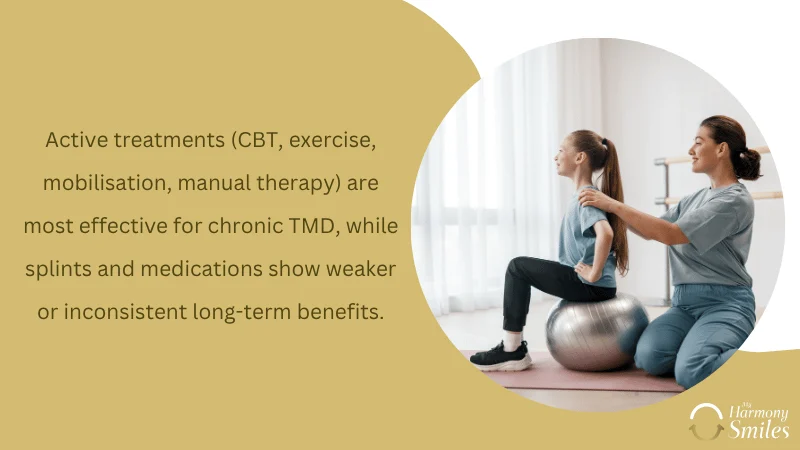
The most important contemporary outcome finding is that active, reversible, non-surgical care outperforms passive or irreversible strategies for chronic TMD pain.
In the 2023 BMJ network meta-analysis of 153 randomised trials involving 8,713 participants, the strongest pain-relief signals came from CBT augmented with biofeedback or relaxation therapy, therapist-assisted jaw mobilisation, and manual trigger-point therapy, each improving the chance of reaching a minimally important pain difference by roughly 32–36 percentage points versus placebo or sham.
The same review found that supervised jaw exercise and stretching, supervised postural exercise, and usual care such as home exercise, self-stretching, reassurance and education were also better than placebo for pain; for physical function, supervised jaw exercise/stretching, manipulation, acupuncture, and jaw exercise plus mobilisation showed moderate-certainty benefit.
The paired BMJ clinical practice guideline translated those findings into practice recommendations for adults with moderate chronic TMD pain lasting at least three months.
It issued strong recommendations in favour of augmented CBT, CBT, Botox, jaw mobilisation, postural exercise, jaw exercise plus stretching, manual trigger-point therapy, and usual care; conditional recommendations in favour of manipulation, acupuncture, jaw exercise plus mobilisation, and CBT plus NSAIDs; conditional recommendations against removable occlusal splints, arthrocentesis, low-level laser therapy, TENS, gabapentin, botulinum toxin injection, hyaluronic acid injection, relaxation therapy alone, trigger-point injection, acetaminophen with or without muscle relaxants/NSAIDs, corticosteroid injection, benzodiazepines, and beta-blockers; and strong recommendations against irreversible oral splints, discectomy, and NSAID-opioid combinations.
The same visual summary notes that serious adverse events are unlikely with exercise and CBT, whereas long-term opioids, NSAIDs, and invasive or irreversible procedures carry a small but important risk of serious harm.
Recent therapy-specific meta-analyses support the same general direction.
A 2023 systematic review of 16 studies and 812 participants found that exercise therapy reduced pain (SMD −0.58), increased active mouth opening (SMD 0.43), and increased passive mouth opening (SMD 0.40).
The review also found that exercise plus splints performed better than splints alone for pain and mouth opening, suggesting exercise should be treated as a core intervention rather than an optional add-on.
For manual therapy versus occlusal splint therapy, a 2024 meta-analysis of 9 studies and 426 patients found manual therapy was more effective for disability reduction (SMD −0.81) and maximal mouth opening (SMD 0.52), while overall pain outcomes were similar; a myogenic subgroup analysis suggested splints may still have a pain advantage for selected patients.
That nuance matters: splints may help some phenotypes, but the average evidence increasingly favours active rehabilitation.
Occlusal splints are where the literature has become more cautious over the past few years.
The 2023 AAFP rapid review still concluded that splints can reduce pain and improve mandibular movement, but it explicitly rated that evidence as lower quality and inconsistent.
By contrast, the 2024 Cochrane review found that splints may reduce chewing muscle pain compared with no treatment, but judged the evidence very uncertain for most comparisons, with little clarity on superiority over placebo, physical therapy, or alternative splint designs.
For research purposes, the defensible summary is that splints remain plausible adjuncts in selected cases, but their average effect is less robust than exercise, mobilisation, and CBT-oriented care. Medication evidence is also mixed.
A 2024 systematic review and meta-analysis concluded there is no single first-choice drug across TMD pain overall, because studies are heterogeneous and outcomes vary by pain mechanism; the same review nevertheless judged NSAIDs to be the most widely used and relatively safest class for acute inflammatory pain.
AAFP’s 2023 review similarly recommends naproxen as initial pharmacotherapy and cyclobenzaprine when muscle spasm is clinically evident.
In other words, short-course NSAID-led pharmacotherapy remains reasonable, but the modern evidence base does not support medication as the primary long-term answer for chronic TMD pain.
Evidence gaps and research cautions
The evidence base remains limited in ways that matter for serious research. Prevalence papers vary widely in case definition, and treatment trials often mix myogenous, arthrogenous, and mixed TMD presentations.
The BMJ evidence synthesis explicitly notes that the evidence for many interventions outside the best-supported active therapies is low or very low certainty, especially for adverse events and outcomes other than pain.
Its visual summary also highlights unresolved uncertainty about subtype-specific effects and the need for better evidence on function, sleep, social outcomes, and harms.
AHRQ’s 2023 topic brief reached a similar conclusion at the evidence-mapping level: it identified many systematic reviews, but none that covered all intervention classes comprehensively, and it found the recent primary literature clustered around injections, photobiomodulation, occlusal devices, and stretching/exercise/manual therapy, with relatively limited evidence in children and adolescents.
The 2025 Royal College of Surgeons guideline therefore treats supported self-management as a foundational package: education, self-exercise, thermal modalities, self-massage, diet and nutrition, and parafunctional behaviour management, with reassessment after 6–8 weeks.
Outlook beyond 2026
I did not identify a robust, validated U.S. forecasting model for TMD prevalence itself, so the most credible way to think beyond 2026 is to combine stable prevalence assumptions with Florida population projections.
Florida’s BEBR medium scenario projects Marion County from 433,765 in 2025 to 471,100 in 2030, Pasco County from 648,369 to 714,900, and Pinellas County from 966,933 to 975,400. If the present U.S.
5–12% prevalence range remains broadly stable, that translates by 2030 into an illustrative burden of roughly 23,555–56,532 people in Marion, 35,745–85,788 in Pasco, and 48,770–117,048 in Pinellas.
The practical implication is straightforward.
Beyond 2026, Pasco and Marion are likely to see the strongest growth in absolute TMD demand because their populations are rising more quickly, while Pinellas will remain a high-burden market because of its sheer size even if growth is modest.
Across all three areas, the treatment literature increasingly supports a service model built around reversible, active, biopsychosocial care — self-management, exercise/stretching, mobilisation/manual therapy, and CBT-based strategies — rather than splint-first, injection-first, or irreversible pathways.
References
Individual and Societal Burden of TMDs
Temporomandibular Disorders: Rapid Evidence Review | AFP
Temporomandibular Disorder Treatment Guidelines
Projections of Florida Population by County, 2030–2050, with Estimates for 2025