

Dental implants have become the gold standard for replacing missing teeth. But patients want to know: what is the dental implants survival rate over 10, 20, or even 30 years?
Patients and dentists alike want answers backed by clinical evidence. The dental implants’ survival rate is consistently high, yet it varies based on implant systems, patient health, and maintenance habits.
This clinical data review examines the latest research on long-term dental implant success, comparing titanium vs zirconia implants, analyzing factors like smoking and diabetes, and explaining why some implants fail.
Whether you are considering implants or already have them, this evidence-based guide will help you understand what modern science says about implant longevity.
Understanding Implant Survival vs Implant Success
Before reviewing survival statistics, it is important to distinguish between implant survival and implant success. These terms are often used interchangeably, but they mean different things in clinical research.
| Aspect | Survival | Success |
| Definition | Implant remains in the mouth | Implant is healthy and fully functional |
| Bone loss | May have some bone loss | Minimal or no bone loss |
| Complications | May have peri-implantitis or prosthetic issues | No complications |
| Patient satisfaction | Not always measured | High satisfaction expected |
An implant can survive for 20 years but still have peri-implantitis, gum inflammation, or a fractured crown. Success means the implant is clinically healthy with no signs of disease or mechanical problems. Most long-term studies report survival, but newer research emphasizes success.
Current Survival Rates of Modern Dental Implants
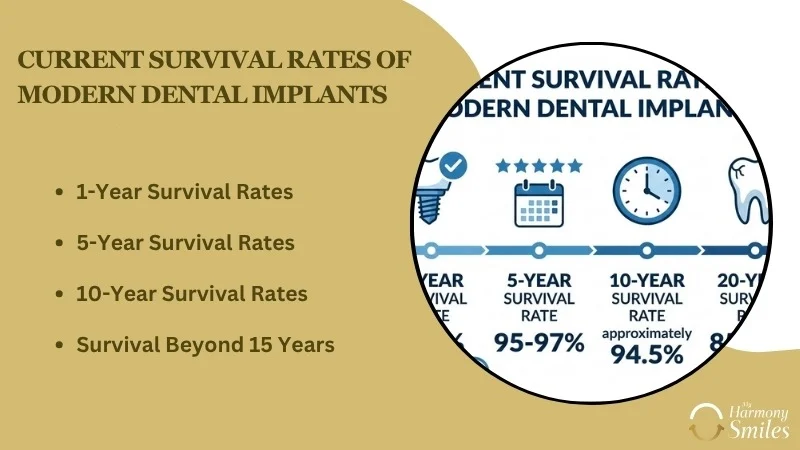
Modern implant systems have evolved significantly. According to a 2024 systematic review in the Journal of Clinical Periodontology, the overall dental implant success rate after 10 years ranges from 90% to 95% for single crowns. Full-arch restorations show slightly lower survival due to increased biomechanical stress.
1-Year Survival Rates
After the first year, implants that have successfully osseointegrated have survival rates above 98%. Early failures (within 3-6 months) are rare, occurring in only 1-2% of cases.
5-Year Survival Rates
At five years, the dental implant success rate after 10 years of studies shows consistent survival of 95-97%. A 2023 multicenter trial of over 2,000 implants reported a 5-year survival of 96.4%.
10-Year Survival Rates
Data from the Swedish National Registry shows that the dental implant success rate after 10 years averages 94.5% for single implants and 92.8% for implant-supported bridges. A 2022 meta-analysis of 48 studies confirmed a 10-year survival of 94.6%.
Survival Beyond 15 Years
Longer follow-up is less common, but available studies show a dental implant success rate after 20 years of approximately 85-90%. For the dental implant success rate after 30 years, data is limited but suggests around 70-80% survival, with most failures due to peri-implantitis.
| Follow-Up Period | Reported Survival Rate |
| 1 year | 98-99% |
| 5 years | 95-97% |
| 10 years | 92-95% |
| 20 years | 85-90% |
| 30 years | 70-80% |
Factors That Influence Dental Implant Survival
Not all implants have the same survival odds. Several clinical factors significantly affect outcomes.
Bone Quality and Quantity
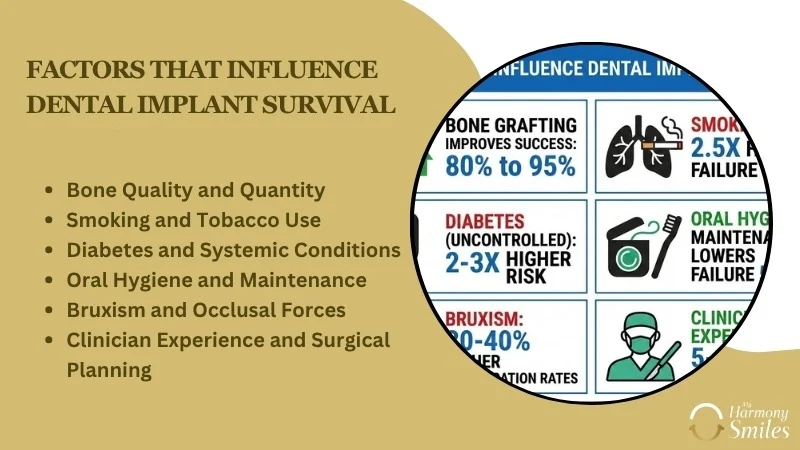
Adequate bone density is essential for osseointegration. The posterior maxilla (upper back jaw) has softer bone and higher failure rates. Bone grafting can improve survival in deficient sites, raising success from 80% to over 95%.
Smoking and Tobacco Use
Smoking is one of the strongest risk factors for implant failure. A 2021 systematic review found that smokers have a 2.5 times higher dental implant failure rate compared to non-smokers. The 10-year survival in smokers is approximately 85% versus 95% in non-smokers.
Diabetes and Systemic Conditions
Controlled diabetes does not significantly reduce implant survival. However, uncontrolled diabetes (HbA1c > 8) increases failure risk by 2-3 times. Patients with well-managed diabetes can expect dental implant success rate after 10 years similar to that of non-diabetics.
Oral Hygiene and Maintenance
Poor oral hygiene leads to peri-implant mucositis, which can progress to peri-implantitis. Patients who attend regular maintenance visits have 50% lower failure rates. Professional cleanings every 6 months are strongly recommended.
Bruxism and Occlusal Forces
Teeth grinding (bruxism) can cause mechanical overload, leading to implant fracture or screw loosening. Studies show that bruxers have 30-40% higher complication rates. Nightguards are essential for these patients.
Clinician Experience and Surgical Planning
Digital planning with CBCT imaging and guided surgery improves implant positioning and survival. Implants placed by experienced clinicians have 5-10% higher survival rates compared to beginners.
Titanium vs Zirconia Implants: Survival Comparison
Titanium has been the standard for decades. Zirconia implants are newer and metal-free.
| Feature | Titanium | Zirconia |
| Clinical history | 50+ years | 15 years |
| Esthetics | Good (can show gray) | Excellent (white) |
| Long-term evidence | Extensive | Limited to 10 years |
| Fracture resistance | Very high | Moderate |
| Surface modifications | Highly developed | Emerging |
| Survival at 10 years | 94-96% | 90-92% |
A 2023 meta-analysis found that zirconia implants have slightly lower survival (91%) compared to titanium (95%) at 5-10 years. However, zirconia is improving and may become comparable with further research. For now, titanium remains the gold standard for implant longevity study outcomes.
Immediate Loading vs Delayed Loading Survival Rates
Immediate loading means placing a temporary crown on the same day as implant surgery. Delayed loading waits 3-6 months for osseointegration.
Studies show that immediate loading has comparable survival rates to delayed loading when strict criteria are met: good bone quality, primary stability >35 Ncm, and no bruxism. A 2022 review reported 5-year survival of 94% for immediate loading vs 96% for delayed loading. The difference is not clinically significant.
Immediate loading offers faster results but requires careful patient selection.
Peri-Implantitis and Implant Failure Risk
Peri-implantitis is the leading cause of late implant failure. It is an inflammatory condition that destroys bone around the implant.
- Common causes: Poor oral hygiene, smoking, a history of periodontitis, and a lack of maintenance.
- Early warning signs: Bleeding on probing, redness, swelling, and deepening pockets.
- Prevention strategies: Daily flossing, professional cleanings, smoking cessation, and treating gum disease before implant placement.
Studies estimate that peri-implantitis affects 18-22% of patients and 10-15% of implants over 10 years. Without treatment, it leads to bone loss and eventual implant failure.
Modern Advances Improving Implant Survival
Several technological advances have improved the survival of modern implant systems:
- Advanced surface technology (SLA, SLActive): Accelerates osseointegration and improves bone bonding.
- Digital implant planning: CBCT imaging allows virtual implant placement before surgery.
- Guided surgery: 3D-printed surgical guides improve accuracy.
- Improved prosthetic materials: Zirconia and high-strength ceramics reduce fractures.
- AI diagnostics: Emerging tools help detect early peri-implantitis.
These innovations have pushed dental implant clinical outcomes to historic highs.
Common Reasons Modern Dental Implants Fail
The following are the stages of the failures along with the common reasons for it:
Early Failure (first 3-6 months)
- Poor osseointegration (often due to low bone density)
- Surgical overheating or contamination
- Undiagnosed infection
- Immediate loading on unstable implants
Late Failure (after 6 months)
- Peri-implantitis (most common)
- Mechanical overload (bruxism, ill-fitting prosthesis)
- Prosthetic fracture or screw loosening
- Progressive bone loss from systemic disease
Patients should watch for pain, mobility, swelling, or bleeding around implants. Early intervention can often save a failing implant.
Clinical Recommendations for Long-Term Implant Success
Based on the evidence, here are key recommendations:
- Proper patient selection: Screen for smoking, diabetes, and gum disease before placement.
- Maintenance protocols: Professional cleanings every 6 months; home care with floss and water flosser.
- Smoking cessation: Quitting before surgery and during healing dramatically improves survival.
- Periodic radiographic evaluation: Annual or biennial X-rays to monitor bone levels.
- Occlusal management: Nightguards for bruxers; avoid excessive forces.
Both clinicians and patients share responsibility for long-term dental implant success.
Future Trends in Implant Survival Research
Research is moving toward:
- Biomimetic surfaces that actively promote bone growth.
- Smart implants with sensors to detect early inflammation.
- Regenerative approaches using growth factors to enhance osseointegration.
- AI-assisted diagnostics for predicting implant failure risk.
- Personalized implant planning based on patient genetics.
Long-term data gaps remain, especially for newer zirconia implants and immediate loading protocols. Standardized reporting will improve future meta-analyses.
Conclusion
Modern dental implants demonstrate an excellent dental implants survival rate, exceeding 95% at 10 years and 85-90% at 20 years.
Success depends on multiple factors: patient selection, oral hygiene, smoking cessation, regular maintenance, and clinician experience. Peri-implantitis remains the biggest threat, but it is preventable with proper care.
The dental implants survival rate evidence is overwhelmingly positive. For most healthy patients, dental implants are a predictable, long-lasting solution for missing teeth.
By understanding the clinical data and following maintenance guidelines, you can maximize your implant’s longevity.
Frequently Asked Questions
What is the average survival rate of modern dental implants?
The average survival rate is 95-97% at 5 years, 92-95% at 10 years, and 85-90% at 20 years.
What factors reduce implant survival rates?
Smoking, uncontrolled diabetes, poor oral hygiene, bruxism, and peri-implantitis are the main risk factors.
Are dental implants permanent?
The implant itself can last a lifetime, but the crown may need replacement after 10-15 years. Implants can fail if disease develops.
Do smokers have more implant failures?
Yes, smokers have a 2.5 times higher failure rate. Quitting before surgery improves outcomes significantly.
What is peri-implantitis?
Peri-implantitis is an inflammatory disease that destroys bone around an implant. It is the leading cause of late implant failure.
Are zirconia implants better than titanium implants?
Zirconia offers better esthetics but has slightly lower long-term survival (90-92% vs 95% for titanium). Titanium remains the gold standard.
How long do full-mouth implants last?
Full-arch implant-supported prostheses have 10-year survival rates of 89-95%, slightly lower than single implants due to greater mechanical stress.
What is the difference between implant survival and implant success?
Survival means the implant remains in place. Success means it is healthy, functional, and free of complications.
Can failed implants be replaced?
Yes. After removal and bone grafting, a new implant can be placed with success rates similar to primary implants.
Does diabetes affect implant longevity?
Controlled diabetes does not significantly affect survival. Uncontrolled diabetes increases failure risk 2-3 times.