

Research scope and central finding
Research on the tooth reimplantation success rate by time shows that prognosis begins changing within the first few minutes after a permanent tooth is knocked out.
Immediate replantation offers the strongest chance of favorable periodontal healing, while longer dry time increases the risk of ankylosis and root resorption.
The emphasis is on evidence published during approximately 2021–September 2026, supplemented by the 2020 International Association of Dental Traumatology (IADT) guideline and one major 2020 human cohort because they remain foundational to interpreting the modern evidence.
The geographic focus is the United States, with specific consideration of Ocala, Palm Harbor and Trinity, Florida, while international clinical studies are included where they provide the best time-stratified human outcome data.
The clearest conclusion is that the popular idea of a single “60-minute golden window” is an oversimplification.
There are really two clinically important thresholds:
The optimal window is immediate replantation, approximately the first 5–15 minutes. During this period periodontal-ligament (PDL) cells on the root surface have the greatest probability of remaining viable.
The IADT describes teeth replanted immediately or within roughly 15 minutes as having PDL cells that are most likely viable, while the AAE describes on-site replantation within about five minutes as the ideal condition.
Sixty minutes is better regarded as a biological damage threshold for dry storage rather than a safe period during which prognosis stays constant.
When total extra-oral dry time is below 60 minutes and the tooth has been kept in an appropriate wet medium, PDL cells may remain viable but are already compromised.
Beyond 60 minutes of total dry time, the PDL is considered probably non-viable and ankylosis/replacement root resorption becomes substantially more likely.
This distinction is central to interpreting “success rates”: every minute does not carry the same prognosis, and a tooth that remains physically present five years later is not necessarily biologically healed.
What “success” actually means
Published replantation studies use different endpoints, which is why apparently contradictory success rates, from under 50% to over 90%, can all be legitimate.
A survival or retention endpoint generally means that the tooth is still in its socket and has not been extracted.
A periodontal-healing endpoint asks whether a functioning PDL has regenerated without ankylosis or pathological root resorption. These are not equivalent.
A replanted tooth may survive for years while being progressively ankylosed and replaced by bone.
The large 2026 Journal of Endodontics cohort explicitly concluded that tooth retention and ankylosis should be interpreted as separate outcomes.
Depending on the condition of the replanted tooth, ongoing care may also involve root canal treatment as part of managing the injured tooth.
That distinction explains much of the variation in reported results. In the 2026 cohort of 248 replanted anterior teeth, estimated five-year retention was 92.9%, yet 41.5% had developed ankylosis.
In contrast, a 2025 paediatric cohort reported five-year survival of only 47.5%, with replacement resorption in 66.7% of teeth.
Directly comparing these figures as though they measure the same form of “success” would therefore be misleading.
For research purposes, the most informative outcome for evaluating the “golden window” is consequently not simply “was the tooth still present?”, but whether increasing extra-oral dry time increases ankylosis, replacement resorption and eventual loss.


What the time-stratified human data show
The strongest recent human evidence shows a pronounced dose-response relationship between delay, particularly dry delay, and unfavourable periodontal healing.
| Elapsed time/storage condition | Study and endpoint | Observed outcome |
| Immediate; <6 min dry and <6 min wet | Gul et al., 2024; long-term ankylosis risk | 17.2% ankylosis |
| <6 min dry, then physiological wet storage for 7–170 min | Gul et al., 2024 | 55.3% ankylosis |
| >60 min dry | Gul et al., 2024 | 85.7% ankylosis |
| ≤5 min dry before saliva storage, mature teeth | Albertsson et al., 2021 | 47.4% ankylosis |
| >5 to <20 min dry before saliva storage, mature teeth | Albertsson et al., 2021 | 76.8% ankylosis |
| >20 min dry before saliva storage, mature teeth | Albertsson et al., 2021 | 89.3% ankylosis |
| Replanted within 1 hour | Roskamp et al., 2023; 5-year tooth retention | 64.0% retained |
| Replanted after >1 hour | Same cohort; calculated from reported groups | 40.5% retained |
The 2024 Gul study provides particularly strong evidence for an immediate-replantation advantage.
It followed 145 replanted permanent teeth from 116 patients for periods ranging from seven months to 23 years.
Ankylosis risk was only 17.2% among teeth replanted immediately, compared with 55.3% after physiological wet storage and 85.7% following more than one hour of dry storage.
Thus, the observed ankylosis risk after >60 minutes dry was approximately five times that of immediate replantation.
The physiological-storage group is also important because it shows that “wet” does not mean “as good as immediate”.
These teeth had been dry for less than six minutes but subsequently remained in saliva or saline for a mean of 59 minutes.
Wet storage preserved prognosis substantially better than prolonged dry storage, but ankylosis was still much more frequent than after immediate replantation.
The 2021 Albertsson study supplies even finer timing information.
Among 89 avulsed and replanted teeth, mature teeth exposed to no more than five minutes of initial dry time before saliva storage had a 47.4% estimated ankylosis risk; this increased to 76.8% after >5–<20 minutes dry and to 89.3% after >20 minutes dry.
The study therefore reinforces a critical point: the deleterious effect of dryness begins well before the one-hour mark.
Saliva can be used temporarily when immediate replantation or a better medium is unavailable, but it does not erase damage already sustained during the dry interval.
Long-term tooth-retention data point in the same direction. In a 2023 five-year retrospective study of 62 permanent teeth, 16 of 25 teeth replanted within one hour remained in their sockets (64%), compared with 15 of 37 delayed beyond one hour, or approximately 40.5%.
The association with extra-alveolar time was statistically significant (p=0.030). Moreover, 22 of the study’s 31 lost teeth had spent more than one hour extra-orally.
The difference was even larger when biological quality of survival was considered: only 12 teeth remained without root resorption after five years, and eight of these had been replanted within the first hour.
A foundational 400-tooth human cohort, re-analysed in 2020, similarly found that ankylosis risk increased significantly as dry-storage time increased and that root maturity modified prognosis.
Even after more than 60 minutes, occasional teeth healed without ankylosis, so the 60-minute boundary is probabilistic, not an absolute point beyond which replantation is biologically impossible.
Interpreting the real “golden window”
Taken together, the evidence supports a graded rather than binary model.
The first few minutes
The first 5–15 minutes constitute the true high-value period. Immediate replacement minimises PDL dehydration and gives the highest probability of normal periodontal healing.
Current guidance describes immediate/on-site replantation as the ideal management condition.
The 2024 clinical data strongly support that biological rationale: only 17.2% ankylosis in immediately replanted teeth versus 55.3% after otherwise favourable physiological storage.
The period up to one hour
The interval from roughly 15 to 60 minutes should be understood as a salvageable but progressively deteriorating window, particularly if the tooth remains dry.
IADT guidance classifies a tooth with less than 60 minutes total dry time and appropriate wet storage as having impaired but potentially viable PDL cells.
Therefore, statements such as “you have one hour to replant the tooth” can be scientifically misleading. The data do not show equivalent outcomes at five minutes and 55 minutes.
They show progressively worsening periodontal prognosis as dry exposure accumulates.
Beyond one hour dry
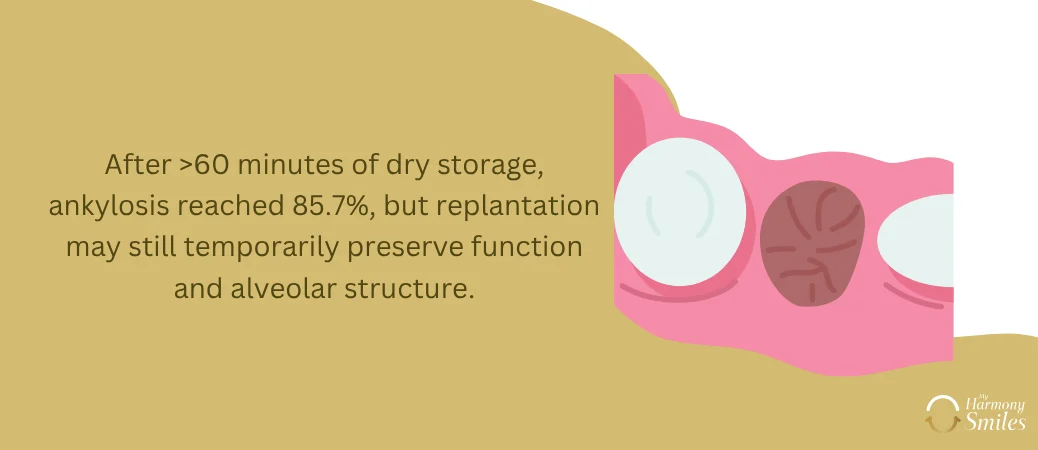
After more than 60 minutes of dry storage, PDL cells are considered probably non-viable, and the expected biological pathway shifts towards ankylosis and replacement resorption.
The 2024 cohort’s 85.7% ankylosis estimate demonstrates the magnitude of that change.
This nevertheless does not mean replantation automatically has no value.
A late-replanted permanent tooth can remain temporarily functional and can preserve aesthetics and alveolar architecture while subsequent treatment is planned; historical human follow-up also demonstrates variation in the rate at which ankylosed roots are resorbed.
The research evidence therefore supports the following interpretation:
Best prognosis: approximately 0–5 minutes.
Very favourable biological window: approximately 5–15 minutes.
Compromised salvage window: 15–60 minutes, strongly influenced by whether the tooth was kept wet.
High-risk delayed replantation: >60 minutes of dry time, where replacement resorption/ankylosis is expected to dominate long-term prognosis.
Evidence from the last five years and the United States
Recent studies reinforce rather than overturn the traditional importance of time.
A 2025 study of 60 replanted permanent teeth in 41 children found replacement resorption in 66.7%, inflammatory resorption in 10%, and estimated five-year survival of 47.5%.
Of teeth developing replacement resorption, 62.5% were eventually lost. The sample was relatively small and paediatric, but it illustrates how periodontal complications can translate into substantial long-term attrition.
At the opposite end of the survival spectrum, the July 2026 Yonsei University cohort included 248 replanted anterior teeth from 180 patients.
Only 19 teeth, or 7.7%, were lost during the observed period, yielding estimated survival of 96.8% at one year and 92.9% at five years. Yet 103 teeth, 41.5%, were ankylosed.
This is perhaps the clearest modern demonstration that long-term retention should not be reported as synonymous with biological success.
The divergence between the 47.5% five-year estimate in the 2025 paediatric study and 92.9% in the 2026 Korean cohort is likely explained at least partly by differences in population, treatment era, case selection, root development, follow-up and failure definitions rather than a genuine twofold change in the intrinsic effectiveness of replantation.
That interpretation is an inference, but it is supported by the substantial differences in study design and by the 2026 investigators’ explicit distinction between retention and ankylosis.
For the United States, the most important development is the AAE’s April 2026 update of its Recommended Guidelines for the Treatment of Traumatic Dental Injuries.
The AAE states that the revised guidance incorporates the IADT 2020 framework, current evidence and structured follow-up recommendations, and stresses that prompt diagnosis and treatment improve the likelihood of preserving traumatised teeth.
U.S. observational evidence confirms that avulsion is also a substantial long-term care burden rather than a one-visit emergency.
A Nationwide Children’s Hospital study in Ohio reported repeated follow-up appointments and significant subsequent care among children with avulsed teeth; its authors emphasised both the poor prognosis that may accompany avulsion and the need for long-term follow-up.
After the initial injury is treated, ongoing cleanings and exams also give the dental team regular opportunities to monitor the health of the teeth, gums, and surrounding oral structures.
For Ocala, Palm Harbor and Trinity, Florida, targeted searches did not identify peer-reviewed city-level cohorts reporting replantation success stratified by elapsed time.
Consequently, assigning a separate “Ocala success rate”, “Palm Harbor success rate” or “Trinity success rate” would not be evidence-based.
The defensible approach is to apply the U.S. AAE/IADT evidence to these communities because the principal prognostic variables, dry time, storage conditions, PDL viability, root maturity and subsequent treatment, are biological and treatment-related rather than city-specific.
Beyond 2026: what can and cannot reasonably be forecast

As of 9 September 2026, there is no validated clinical forecasting model demonstrating that future technology will materially extend the biological replantation window.
The current 2026 AAE guideline still emphasises rapid management and remains grounded in the IADT framework rather than replacing the time-dependent model.
The most promising research frontier is periodontal-ligament regeneration.
AAE research commentary describes experimental strategies involving PDL stem-cell sheets, platelet-rich fibrin, extracellular-matrix engineering, cryopreserved PDL stem cells and potentially three-dimensional bioprinting.
These approaches are aimed particularly at teeth whose PDL has been severely compromised by prolonged extra-oral exposure, but the AAE characterises the cell-based evidence as preliminary and notes the need for more standardised protocols.
Regenerative endodontics is also being investigated in delayed replants.
A 2026 observational report involving traumatised anterior teeth described regenerative treatment in a small subset of avulsed teeth with resorptive complications, but such evidence is far too limited to conclude that regeneration can neutralise the adverse effect of delayed replantation.
Accordingly, the evidence-based forecast beyond 2026 is not that the golden window will disappear, but that research may improve management of teeth already damaged outside it.
Until controlled human evidence demonstrates otherwise, the priority remains preventing PDL death in the first place through the shortest possible dry time.
Research conclusion
The modern evidence supports a more precise interpretation of the “golden window” than the frequently repeated one-hour rule.
Immediate replantation within approximately five minutes produces the best periodontal prognosis; the first 15 minutes remain highly biologically important.
Once dry exposure accumulates, the probability of ankylosis rises rapidly. In one 2021 human study of mature teeth subsequently stored in saliva, ankylosis increased from 47.4% after ≤5 minutes dry to 76.8% after >5–<20 minutes and 89.3% beyond 20 minutes.
The 60-minute threshold remains clinically meaningful, but it marks probable loss of PDL viability rather than the end of a uniformly “safe” hour.
The strongest recent long-term comparison found ankylosis in 17.2% of immediately replanted teeth, 55.3% following favourable wet storage and 85.7% after more than 60 minutes dry.
Long-term tooth retention can still occur despite poor periodontal healing.
A 2023 cohort showed five-year retention of 64% for teeth replanted within one hour versus approximately 40.5% after longer delays, whereas a large 2026 cohort reported 92.9% five-year survival overall but 41.5% ankylosis.
“Success rate” should therefore always specify whether the endpoint is retention, ankylosis-free healing, absence of root resorption, or functional survival.
Once the immediate trauma has been managed, ongoing preventative dentistry can support routine oral health monitoring alongside any injury-specific follow-up recommended by the treating dentist.
For research and public-health communication in Ocala, Palm Harbor, Trinity and the wider United States, the most scientifically accurate message is therefore:
The golden window begins immediately, not at the end of an hour.
Five minutes is substantially better than 30–60 minutes; keeping the tooth physiologically wet can preserve remaining PDL viability when immediate replantation is impossible; and after more than 60 minutes dry, replantation may still preserve the tooth temporarily, but biological healing becomes markedly less favourable.
References
Clinical Outcome of Replanted Avulsed Anterior Teeth: A Retrospective Cohort Study – ScienceDirect
The risks of ankylosis of 89 avulsed human teeth stored in …
Risk of ankylosis of 400 avulsed and replanted human …