
Have you given up on eating your favorite foods because your dentures slip and wobble?
Do you hide your smile because you are missing most of your teeth?
You are not alone.
Many people in Florida and surrounding areas live with the daily frustration of uncomfortable dentures or embarrassing gaps. But there is a permanent solution that can give you back your confidence and your ability to enjoy life.
The hybrid dental implant process offers a fixed, non removable set of teeth that look natural, feel secure, and let you eat whatever you want.
This complete guide walks you through every step of the hybrid dental implant process in Trinity, FL.
You will learn how it works, how long it takes, what it costs, and why so many patients choose this life changing treatment. By the end, you will know exactly what to expect from start to finish.
What Are Hybrid Dental Implants?

Hybrid dental implants are a fixed full arch restoration that replaces an entire upper or lower set of teeth using4 to 6 titanium implants. The implants are surgically placed into your jawbone. Then a custom made bridge of prosthetic teeth is permanently screwed onto those implants.
The result is a complete arch of teeth that never comes out. Only a dentist can remove them for maintenance or repair.
Other names for hybrid dental implants include:
- All-on-X, All-on-4, or All-on-6 dental implants
- Fixed implant supported dentures
- Teeth in a day
- Permanent dentures
- Full arch of full mouth dental implants
- Implant-supported hybrid prosthesis
Hybrid dental implants are completely different from removable dentures. Traditional dentures rest on your gums and can shift, click, or fall out. They cover the roof of your mouth, affecting your taste and triggering your gag reflex.
Hybrid implants are anchored directly into your jawbone. They do not move. They do not cover your palate. They feel and function like natural teeth.
Key characteristics of hybrid implants:
- Fixed (non removable by the patient)
- Supported by 4, 5, or 6 titanium implants per arch
- The prosthetic bridge is made of acrylic, porcelain, or zirconia
- Provides up to 90% of natural chewing power
- Prevents jawbone loss and facial collapse
Hybrid Dental Implant Process vs Other Options: A Clear Comparison
Before exploring the step-by-step process, it helps to understand how hybrid implants compare to other tooth replacement options. Many patients search for terms like hybrid denture vs overdenture or hybrid denture vs All-on-4. Let us clarify these differences.
Hybrid dentures is another name for fixed hybrid implants. The term “denture” can be confusing because traditional dentures are removable. But in dental terms, a hybrid denture is a fixed prosthesis that combines the stability of implants with the esthetics of a full set of teeth.
Overdentures are removable dentures that snap onto 2 to 4 implants. You take them out at night to clean them and let your gums rest. They are more stable than regular dentures but still removable.
All-on-4 is a specific type of hybrid implant that uses exactly 4 implants per arch. The posterior implants are tilted at 30 to 45 degrees to maximize contact with available bone. All-on-4 is the most common hybrid implant design.
Types of hybrid dentures vary based on materials and the number of implants. The main types are:
| Type | Number of Implants | Material | Best For |
| All-on-4 | 4 | Acrylic or zirconia | Most patients, cost effective |
| All-on-6 | 6 | Acrylic or zirconia | Extra stability, heavy bite force |
| Acrylic hybrid | 4-6 | High impact acrylic | Lower cost, easy repair |
| Zirconia hybrid | 4-6 | Solid zirconia | Maximum esthetics and durability |
Who Is a Good Candidate for Hybrid Dental Implants in Trinity, FL?
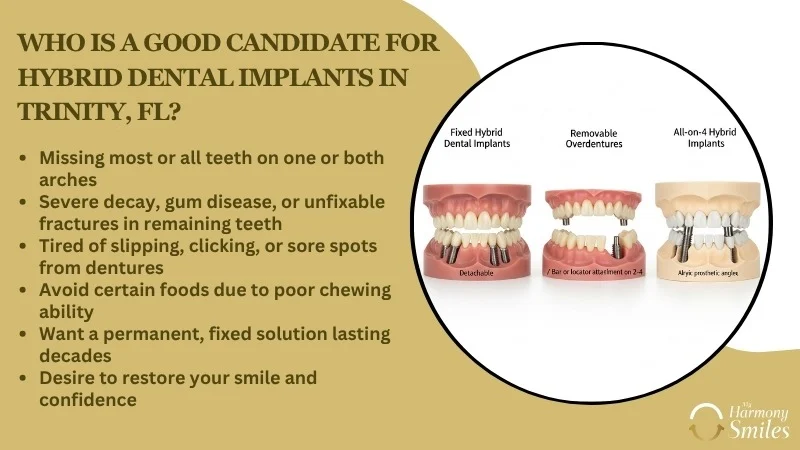
You may be a good candidate for dental implants in Trinity, FL if you answer yes to any of these questions:
- Are you missing most or all of your teeth on your upper arch, lower arch, or both?
- Do your remaining teeth have severe decay, gum disease, or fractures that cannot be saved?
- Are you tired of wearing uncomfortable dentures that slip, click, or cause sore spots?
- Do you avoid certain foods because you cannot chew them properly?
- Are you looking for a permanent, fixed solution that will last for decades?
- Do you want to restore your smile and your confidence?
Health requirements:
- Good general health or well managed chronic conditions
- Enough jawbone density to support implants (bone grafting can help if needed)
- Healthy gum tissue (gum disease must be treated first)
- Non smoker or willing to quit during healing
What about bone loss? Many patients worry that they have lost too much jawbone to qualify for implants. This is rarely a permanent barrier. Bone grafting procedures can rebuild lost bone.
According to the American Academy of Periodontology, bone grafting for dental implants has a success rate of over 90% when performed by experienced clinicians. The graft material may come from your own body, a donor, or synthetic sources. After grafting, you typically wait 4 to 6 months before implant placement.
What about age? There is no upper age limit for hybrid implants. Studies published in theJournal of Oral Implantology have shown successful outcomes in patients in their 80s and 90s. The key is overall health, not age.
Step by Step: The Hybrid Dental Implant Process
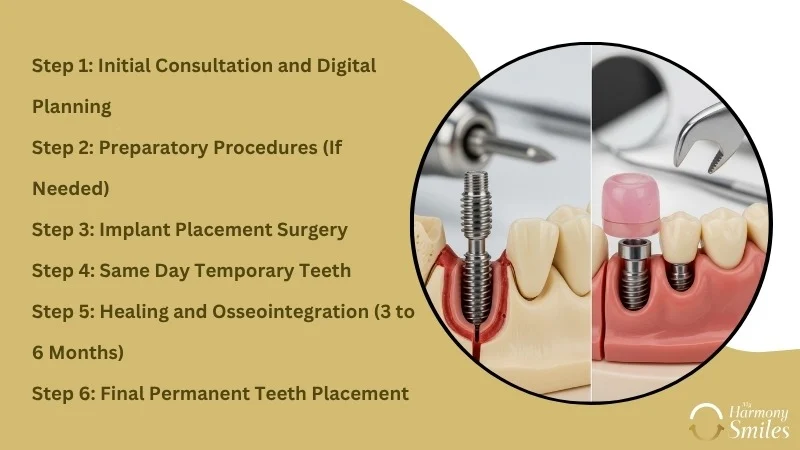
Now, let us walk through exactly what happens during the hybrid dental implant process in Trinity, FL. We will cover each phase in detail, including what you feel, how long it takes, and what to expect afterward.
Step 1: Initial Consultation and Digital Planning
Your journey begins with a comprehensive consultation. This first visit takes about 60 to 90 minutes. Here is what happens:
- Medical and dental history review: Your dentist will ask about past surgeries, medications, allergies, and any chronic conditions like diabetes or heart disease.
- Oral examination: The dentist checks your remaining teeth, gums, and jawbone.
- 3D CBCT scan: This is the most important diagnostic tool. The cone beam CT scanner rotates around your head, capturing over 600 images to create a three-dimensional model of your jawbone, nerves, sinuses, and teeth. The radiation exposure is very low, about the same as a few dental X-rays.
- Treatment planning: Using the CBCT data, your dentist plans exactly where each implant will go. The software shows bone density and warns of nearby nerves or sinuses.
- Discussion of goals and options: You will see a digital mockup of your new smile. Your dentist explains the hybrid dental implant process steps, sedation options, timeline, and cost.
By the end of this visit, you will have a clear treatment plan and a written estimate. You can ask any questions about hybrid denture vs overdenture or hybrid denture vs All-on-4 to make sure you choose the right option for your needs.
Step 2: Preparatory Procedures (If Needed)
Between 20% and 40% of patients need some preparation before implant placement. Common preparatory procedures include:
- Tooth extractions: Any remaining failing teeth are gently removed. In many cases, extractions and implant placement happen on the same day.
- Bone grafting: If your CBCT scan shows insufficient bone, graft material is placed to build up the area. Healing takes 4 to 6 months.
- Sinus lift: For upper back jaw implants, the sinus membrane may need to be lifted and bone graft placed underneath. This adds 4 to 6 months to your timeline.
- Gum disease treatment: Active periodontitis must be treated with scaling, root planing, and possibly antibiotics before implants can be placed.
Step 3: Implant Placement Surgery
This is the main surgical day. You will receive sedation to keep you comfortable and anxiety free. Options include:
- Local anesthesia with oral sedation: You are awake but relaxed. You take a pill before the procedure.
- IV moderate sedation (twilight sleep): You are conscious but very drowsy. Most patients remember nothing of the surgery. This is the most popular choice.
- General anesthesia: You are completely asleep. Reserved for complex cases or very anxious patients.
What happens during surgery:
- Your mouth is numbed with local anesthetic even if you are sedated.
- The dentist makes small incisions in your gum tissue to expose the jawbone.
- Using a 3D printed surgical guide, the dentist drills precise holes for each implant.
- Titanium implants are screwed into the holes.
- Healing caps or abutments are placed on top of the implants.
- In many cases, a temporary fixed bridge is attached the same day.
The surgery takes 2 to 4 hours for one arch, or 4 to 6 hours for both arches. You will need a driver to take you home. Most patients describe the experience as painless and surprisingly easy.
Step 4: Same-Day Temporary Teeth
One of the most exciting parts of the hybrid dental implant process is that you usually leave the office with a new smile. In about 70% to 80% of cases, the dentist attaches a temporary prosthetic bridge on the same day as surgery. This template is made of acrylic and is screwed onto the implants.
Benefits of same-day teeth:
- You never have to go without teeth
- You can smile, speak, and eat soft foods immediately
- The temporary protects the implants during healing
- Your confidence gets an instant boost
If same-day teeth are not possible due to poor bone quality or other factors, you will wear a conventional denture during healing. Your dentist will make it as comfortable as possible.
Step 5: Healing and Osseointegration (3 to 6 Months)
After surgery, your body begins the natural process of osseointegration. The titanium implants fuse with your living jawbone. This creates an incredibly strong bond that mimics the connection between natural teeth and bone.
What happens during healing:
- You follow a soft food diet for 4 to 8 weeks
- You practice gentle oral hygiene around the implants
- You avoid biting directly into hard foods with the temporary teeth
- You attend follow-up appointments at 2 weeks, 1 month, 3 months, and 6 months
- X-rays are taken periodically to monitor bone growth
The healing phase is critical. According to research published in Clinical Oral Implants Research, the success rate of osseointegration is 98% when patients follow postoperative instructions. The most common cause of failure during this phase is smoking or eating hard foods too soon.
Step 6: Final Permanent Teeth Placement
Once your implants have fully integrated (usually after 4 to 6 months), you are ready for your permanent teeth. The process takes 2 to 3 weeks:
- Your dentist removes the temporary bridge.
- Digital impressions are taken of your implants and surrounding gums.
- The impressions are sent to a dental laboratory.
- Skilled technicians craft your final bridge using CAD/CAM technology (computer-aided design and computer-aided milling).
- Your final prosthesis is made from either high-impact acrylic or solid zirconia.
- You return to the office for the final fitting.
- The permanent bridge is screwed onto the implants and torqued to the proper specification.
- The screw access holes are filled with composite resin, making the bridge look completely natural.
Your final teeth are fully customized for:
- Color (shade matching to your skin tone and age)
- Shape (proportions that complement your face)
- Size (proper lip support and smile line)
- Bite (even contact for comfortable chewing)
How Long Does the Entire Hybrid Dental Implant Process Take?
The total timeline varies by patient. Here is a realistic breakdown:
| Phase | Duration |
| Initial consultation and planning | 1 to 2 weeks |
| Preparatory procedures (if needed) | Adds 4 to 6 months |
| Implant placement surgery | 1 day (2-4 hours per arch) |
| Temporary teeth placement | Same day as surgery (in most cases) |
| Initial soft food healing | 2 to 4 weeks |
| Osseointegration | 3 to 6 months |
| Final permanent teeth fabrication | 2 to 3 weeks |
| Total for the straightforward case | 4 to 6 months |
| Total with bone grafting or sinus lift | 9 to 12 months |
Factors that can shorten or lengthen your timeline:
- Healing speed (younger, healthier patients heal faster)
- Compliance with diet and hygiene instructions
- Smoking status (smokers heal more slowly)
- Quality of bone (dense bone integrates faster than soft bone)
Is the Hybrid Dental Implant Procedure Painful?
This is the most common fear, and the honest answer is reassuring. During the surgery, you will be under sedation and local anesthesia. You will feel no pain. You may feel pressure or vibration, but nothing sharp or uncomfortable.
After the sedation wears off, you will experience some soreness. However, most patients rate their postoperative pain as mild.
A study of 200 hybrid implant patients found that the average pain score on day 1 was 2.7 out of 10. By day 3, it was 1.5. By day 7, it was 0.5. Over-the-counter pain medication like ibuprofen or acetaminophen usually controls the discomfort. Only about 5% of patients need prescription narcotics beyond the first 48 hours.
Pain management tips:
- Take the first dose of pain medication before the local anesthetic wears off
- Apply ice packs to your face for the first 48 hours (20 minutes on, 20 minutes off)
- Sleep with your head elevated on two pillows
- Eat cold soft foods like ice cream and smoothies on the first day
- Avoid hot foods, straws, and spitting for the first week
Recovery and Aftercare Expectations: Detailed Timeline
Here is the realistic timeline and the aftercare expectations that you need to follow for a smooth recovery.
First 24 Hours
- Bleeding is normal; bite on gauze for 30 to 60 minutes
- Swelling begins; use ice packs aggressively
- Eat only cold, soft foods and liquids
- Do not rinse, spit, or use straws
- Rest with head elevated
Days 2 to 3
- Swelling peaks; continue ice packs for the first 48 hours, then switch to warm compresses
- Pain is manageable with over the counter medication
- You may rinse gently with warm salt water (but do not swish forcefully)
- Progress to warm soft foods like mashed potatoes, scrambled eggs, and soup
Days 4 to 7
- Swelling begins to subside
- You can return to non-strenuous work
- Avoid chewing on the surgical site
- Continue salt water rinses 4 to 5 times daily
- Most patients stop all pain medication by day 5
Weeks 2 to 4
- You feel mostly normal
- You can eat semi-soft foods like pasta, soft bread, and tender chicken
- Avoid nuts, chips, raw vegetables, and sticky candies
- Brush your temporary teeth gently with a soft toothbrush
- Use a water flosser on a low setting to clean underneath the bridge
Months 1 to 6 (Healing Phase)
- You gradually add firmer foods
- By month 3, you can eat most cooked foods, cut into small pieces
- By month 6 (after osseointegration is confirmed), you can eat a normal diet
- Continue excellent oral hygiene
- Attend all scheduled follow up appointments
After Final Teeth Placement
- Your diet is completely normal; enjoy steak, apples, nuts, and corn on the cob
- Brush your hybrid implants twice daily with a soft toothbrush and non-abrasive toothpaste
- Floss underneath the bridge using superfloss or a water flosser
- Schedule professional cleanings every 6 months
- Wear a nightguard if you grind your teeth
Benefits of Hybrid Dental Implants
Choosing the hybrid dental implant process offers life-changing advantages over dentures or other alternatives.
Permanent, Fixed Solution
Your new teeth never come out. You never have to soak them overnight. You never need messy adhesives. They are areas close to natural teeth that modern dentistry can provide.
Eat Anything You Want
With traditional dentures, you give up steak, apples, nuts, and corn on the cob. With hybrid implants, you eat all those foods again. The implants restore up to 90% of your natural biting force.
Preserve Your Jawbone and Facial Structure
When you lose teeth, your jawbone shrinks. This leads to a sunken, aged appearance. Hybrid implants stimulate the bone just like natural roots, preventing bone loss and keeping your face looking young.
A study in the Journal of Oral Rehabilitation found that patients with fixed hybrid implants maintained 95% of their jawbone height over 10 years, while denture wearers lost an average of 5 millimeters.
No Palate Coverage
Traditional dentures cover the roof of your mouth, which interferes with taste and triggers gagging. Hybrid implants leave your palate uncovered. You can taste food fully and speak without gagging.
Improved Speech
Dentures can click, whistle, or slip, making you slur your words. Hybrid implants are fixed, so your speech is clear and natural.
Boosted Confidence
This is perhaps the most important benefit. Patients report smiling more, laughing freely, and feeling proud of their appearance. A survey of hybrid implant patients found that 97% said their quality of life improved significantly after treatment.
Hybrid Implants vs Dentures vs All-on-4: Detailed Comparison Table
| Feature | Hybrid Dental Implants (Fixed) | Traditional Dentures (Removable) | Implant-Supported Overdentures (Removable) |
| Stability | Fixed, never moves | Slips and shifts | Snaps onto implants but can move |
| Removal by patient | No (only the dentist removes) | Yes (daily) | Yes (daily) |
| Chewing power | 90% of natural | 20-30% of natural | 60% of natural |
| Bone preservation | Yes | No | Some |
| Palate coverage | No | Yes | No (if bar retained) |
| Maintenance | Brush and floss | Soak overnight, adhesives | Remove, clean, snap back |
| Comfort | Feels natural | Sore spots common | Better than regular dentures |
| Longevity | Implants lifetime; bridge 10-15 years | 5-8 years | Implant lifetime: denture 5-8 years |
| Upfront cost per arch | $15,000-$35,000 | $1,500-$5,000 | $6,000-$15,000 |
Hybrid denture vs All-on-4: These terms are often used interchangeably. All-on-4 is a specific type of hybrid denture that uses exactly 4 implants. Other hybrid designs may use 5 or 6 implants. Your dentist will recommend the right number based on your bone and bite.
Cost of Hybrid Dental Implants in Trinity, FL
One of the most common questions patients ask is, “How much do snap-in denture implants cost?” The term snap-in denture implants typically refers to implant-supported removable overdentures.
Fixed hybrid implants cost more because they require more implants and a more complex prosthesis.
Average costs in the Trinity, FL area:
- Hybrid dental implants (fixed, single arch): $18,000 to $35,000
- Both arches (full mouth): $35,000 to $70,000
- Implant-supported overdentures (removable, single arch): $8,000 to $18,000
- Traditional dentures (single arch): $1,500 to $5,000
What affects the final cost:
- Number of implants placed (4, 5, or 6 per arch)
- Material of the final bridge (acrylic vs zirconia)
- Need for bone grafting or sinus lifts (adds $1,500 to $5,000 per site)
- Type of sedation (IV sedation adds $500 to $1,000)
- Experience of the implant dentist
What is included in the quoted price:
- Initial consultation and CBCT scan
- Treatment planning
- Implant placement surgery
- Temporary prosthetic (if same day)
- All follow-up appointments during healing
- Final permanent bridge
- 1 year of postoperative care
Financing options available:
At My Harmony Smiles, we offer flexible payment plans to make hybrid dental implants affordable. Options include CareCredit, Proceed Finance, and Cherry payment plans. Monthly payments can be as low as $300 to $500 per month, depending on your credit and loan term.
Long-term value: While the upfront cost is higher than that of dentures, hybrid implants save you money over 20 years. Dentures need replacement every 5 to 8 years, plus adhesives, relines, and repairs. The total 20-year cost of dentures often exceeds $20,000. Hybrid implants may need only one bridge replacement in 20 years, with no ongoing adhesive costs. More importantly, you gain a quality of life that dentures can never provide.
Why Choose a Local Implant Specialist
When you invest in hybrid dental implants, you want an experienced provider close to home. Choosing a dentist in Trinity, FL offers several advantages:
- Convenience: Multiple visits are required for consultation, surgery, follow-ups, and final placement. A local provider saves you travel time.
- Emergency care: If you have a problem with your temporary or final bridge, your dentist is nearby.
- Familiarity with local patients: Dentists in Trinity understand the needs of patients in Pasco County, including nearby communities like New Port Richey, Holiday, and Tarpon Springs.
- Continuity of care: You build a long-term relationship with your dentist for maintenance and future needs.
What to look for in a hybrid implant specialist:
- Advanced training in implant dentistry (fellowship in ICOI or AAID)
- Experience with full arch cases (ask how many hybrid cases they have placed)
- In office 3D CBCT scanner and digital planning software
- Positive patient reviews and before/after photos
Transparent pricing and financing options
At My Harmony Smiles, our implant team has placed over 200 full arches since 2019. We use the latest technology, including CBCT imaging, intraoral scanning, computer-guided surgery, and CAD/CAM prosthetics. Every patient receives a personalized treatment plan. We serve patients from Trinity, New Port Richey, and all of Pasco County.
Frequently Asked Questions
How long do hybrid dental implants last?
The titanium implants can last a lifetime with proper oral hygiene and regular dental checkups. The acrylic or zirconia bridge typically lasts 10 to 15 years before needing replacement due to normal wear and tear.
Can I eat normally with hybrid implants?
Yes. After full healing (about 6 months), you can eat all foods, including steak, apples, nuts, popcorn, and corn on the cob. During the healing phase, you must follow a soft to semi-soft diet to protect the implants while they fuse with bone.
Are hybrid implants better than dentures?
For most patients, yes. Hybrid implants are fixed, do not slip, preserve jawbone, and restore near natural chewing power. Dentures are removable, cause bone loss, and limit your diet. However, dentures have a lower upfront cost. The choice depends on your budget and priorities.
How do I clean hybrid dental implants?
- Brush your hybrid bridge twice daily with a soft toothbrush.
- Use superfloss (a stiff-ended floss with a spongy middle) to thread underneath the bridge and clean the gum area.
- A water flosser on low pressure is also very effective. Your dentist will show you the proper technique.
What if I do not have enough bone for implants?
Bone grafting can rebuild lost bone. The graft material stimulates your body to grow new bone over 4 to 6 months. After healing, implants can be placed safely. According to the American Dental Association, bone grafting for dental implants has a success rate of over 90%.
Is the procedure safe for older adults?
Yes. Age alone is not a risk factor. Studies show that healthy patients in their 80s and 90s have implant success rates similar to those of younger patients. We evaluate each patient individually based on health status, not age.
How much do snap-in denture implants cost?
Snap-in denture implants (implant-supported overdentures) typically cost $8,000 to $18,000 per arch. This is lower than fixed hybrid implants because fewer implants are used and the prosthesis is removable. Ask your dentist for a detailed quote.
Conclusion
The hybrid dental implant process in Trinity, FL, is a proven, life-changing solution for patients missing most or all of their teeth.
- You can eat your favorite foods again.
- You can smile without embarrassment.
- You can speak clearly without clicking or slipping.
- You can preserve your youthful facial structure for decades.
The journey takes 4 to 6 months for most patients, with same-day temporary teeth, so you never go without a smile. The procedure is not as painful as you might fear.
Modern sedation and pain management make it comfortable. The investment is significant, but the long-term value and quality of life improvements are priceless.
If you are tired of living with uncomfortable dentures or embarrassing gaps, take the first step today.
Schedule a consultation at My Harmony Smiles in Trinity, FL. Our experienced implant specialists will evaluate your needs, answer your questions about hybrid denture vs All-on-4 and hybrid denture vs overdenture, and create a personalized treatment plan.
We offer flexible financing to fit your budget. Restore your smile and your confidence. Contact us now to book your appointment.