


Do you find yourself covering your mouth when you laugh? Do you hesitate to smile in photos because you feel like your gums show too much? If so, you are not alone. A gummy smile treatement (clinically known as excessive gingival display) is a common concern that affects many people’s confidence and willingness to smile freely.
The good news is that modern cosmetic dentistry offers a range of effective gummy smile treatment options. Whether you are looking for a quick, non-surgical fix or a permanent solution, there is a treatment that can help you achieve a more balanced, confident smile.
This guide explores the causes of a gummy smile, the most effective treatments available, and what you can expect from each option.
Table of Content
- What Is a Gummy Smile?
- What Causes a Gummy Smile?
- How Dentists Determine the Best Treatment
- Comparison Table: Most Effective Gummy Smile Treatments
- Non-Surgical Treatments for a Gummy Smile
- Surgical Treatments for a Gummy Smile
- Which Gummy Smile Treatment Is Right for You?
- Recovery Time and What to Expect After Treatment
- Are Gummy Smile Treatments Permanent?
- Benefits of Treating a Gummy Smile
- Frequently Asked Questions About Gummy Smile Treatments
What Is a Gummy Smile?

A gummy smile occurs when an excessive amount of gum tissue is visible above the upper teeth when smiling. Generally, more than 3 to 4 millimeters of visible gum tissue is considered excessive.
While some gum display is normal and even attractive, too much can make teeth appear small and throw off the natural balance of your smile.
For many people, a gummy smile is a source of self-consciousness. It can affect social interactions, professional confidence, and overall quality of life.
Fortunately, understanding the underlying cause is the first step toward finding the right gummy smile correction approach.
What Causes a Gummy Smile?
A gummy smile can result from one or more factors. Identifying the specific cause is essential for choosing the most effective excessive gingival display treatment.
Excessive Gum Tissue
Some people simply have more gum tissue covering their teeth than average. This can make perfectly normal-sized teeth appear short and stubby. This condition, known as altered passive eruption, occurs when the gum tissue does not recede enough as the teeth emerge.
Hyperactive Upper Lip
The muscles that control your upper lip may be overactive, causing your lip to rise higher than normal when you smile. This exposes more gum tissue than intended. Botox injections are particularly effective for this type of gummy smile.
Short Upper Lip
Some people have a naturally short upper lip that does not cover enough of the gum tissue, even at rest. This can be addressed through lip repositioning surgery.
Small or Worn Teeth
Teeth that are naturally small or have been worn down over time can make the gums appear more prominent by comparison. Crowns, veneers, or crown lengthening can help balance the proportions.
Jaw Development Issues
In some cases, the upper jaw is positioned too low relative to the rest of the face. This is known as vertical maxillary excess. It is a skeletal issue that may require orthognathic (jaw) surgery for full correction.
How Dentists Determine the Best Treatment
Before recommending any gummy smile treatment, a dentist or periodontist will conduct a thorough evaluation. This typically includes:
- Smile analysis: assessing how much gum shows when you smile naturally
- Facial proportions: evaluating how your smile fits with your overall facial features
- Lip movement evaluation: measuring how far your upper lip rises
- Gum and tooth assessment: checking the health and proportions of your gum tissue and teeth
- Bite evaluation: examining your jaw alignment
- Digital imaging: using photographs and sometimes 3D scans to plan your treatment
This comprehensive approach ensures that the treatment addresses the root cause of your gummy smile, not just the symptoms.
Comparison Table: Most Effective Gummy Smile Treatments
| Treatment | Best For | Surgical? | Recovery Time | Longevity |
| Botox | Hyperactive lip muscles | No | None | 4–6 months |
| Laser Gum Contouring | Excess gum tissue | Minimally invasive | 1–2 weeks | Permanent |
| Gingivectomy | Excess gum tissue | Yes | 1–2 weeks | Permanent |
| Crown Lengthening | Short teeth, excess gum | Yes | 2–4 weeks | Permanent |
| Lip Repositioning | Hyperactive lip, short lip | Yes | 1–2 weeks | Long-term |
| Orthodontics | Dentoalveolar causes | No | Ongoing | Permanent |
| Orthognathic Surgery | Skeletal jaw issues | Yes | 4–6 weeks | Permanent |
Non-Surgical Treatments for a Gummy Smile
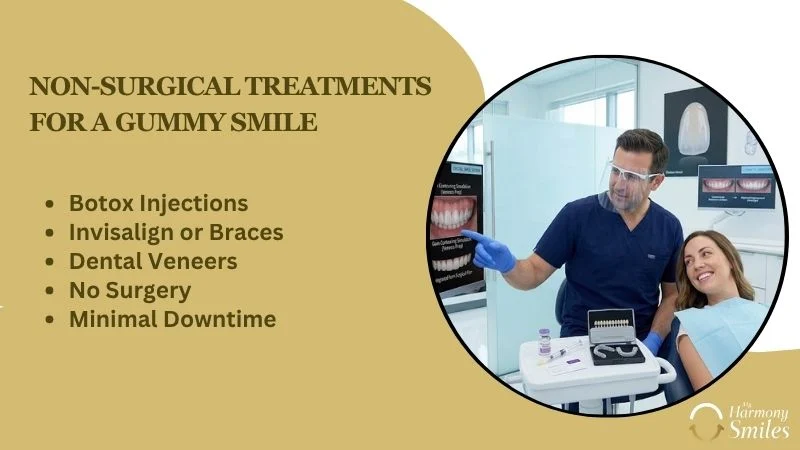
If you are looking for a less invasive approach, there are several effective non-surgical gummy smile treatment options.
Botox for a Gummy Smile
Botox (botulinum toxin type A) is one of the most popular non-surgical treatments for a gummy smile. It works by relaxing the muscles that pull your upper lip upward when you smile. By reducing the lip’s upward movement, less gum tissue is exposed.
What to expect:
- The procedure takes about 10–15 minutes
- Results appear within 1 week
- Effects typically last 4 to 6 months
- No downtime; you can return to normal activities immediately
- Botox reduces gingival exposure by 3 to 5 millimeters
Pros:
- Quick and minimally invasive
- No recovery time
- Affordable compared to surgical options
- Great option to “test drive” a more balanced smile
Cons:
- Temporary; requires repeat treatments every few months
- Not suitable for all types of gummy smiles (only those caused by muscle hyperactivity)
Orthodontic Treatment (Braces or Invisalign)
In some cases, orthodontic treatment can reduce a gummy smile. This is particularly effective when the cause is related to tooth position rather than gum tissue or lip movement.
Orthodontists may use:
- Traditional braces
- Clear aligners like Invisalign
- Miniscrew-assisted orthodontic correction
By intruding (pushing upward) the upper front teeth, orthodontics can reduce the amount of gum displayed when smiling.
Dental Veneers or Crowns
If your teeth appear small or worn, veneers or crowns can be used to lengthen them, reducing the relative amount of gum showing. This is often combined with other treatments for a comprehensive smile makeover.


Surgical Treatments for a Gummy Smile
For patients seeking a permanent solution, surgical gummy smile correction options provide long-lasting results.
Laser Gum Contouring
Laser gum contouring is a minimally invasive procedure that uses a dental laser to reshape the gum line and remove excess gum tissue.
What to expect:
- Treatment usually takes 1–2 hours
- The laser cauterizes tissue as it cuts, reducing bleeding and promoting faster healing
- Most people recover within a week
- Full healing of gum tissue takes about 2–4 weeks
Benefits:
- Precise treatment
- Minimal bleeding
- Fast recovery
- Permanent results
Laser gum contouring is best for patients with excess gum tissue that makes their teeth appear short.
Gingivectomy
A gingivectomy is a more traditional surgical procedure to remove excess gum tissue. While laser contouring has largely replaced this method, it is still used in certain cases where more extensive tissue removal is needed.
Crown Lengthening
Crown lengthening is a surgical procedure that removes excess gum tissue and, in some cases, a small amount of bone to expose more of the natural tooth structure.
What to expect:
- Small incisions are made in the gum to create a flap
- The underlying bone may be reshaped
- Healing takes 2–4 weeks
- Often performed before placing crowns or veneers
Crown lengthening is particularly effective when teeth appear short due to excess gum coverage. Advanced techniques now use 3D-printed surgical guides for enhanced precision.
Lip Repositioning Surgery
Lip repositioning surgery is a powerful, relatively non-invasive surgical approach for treating a gummy smile. The procedure limits the upward movement of the upper lip by reducing the depth of the upper vestibule.
What to expect:
- Performed in an outpatient setting
- Recovery typically takes 1–2 weeks
- Provides long-term aesthetic results
Lip repositioning is especially effective for patients with hyperactive lip muscles or a short upper lip.
Orthognathic Surgery
For patients with skeletal causes of a gummy smile (vertical maxillary excess), orthognathic (jaw) surgery is the most definitive treatment. This procedure involves surgically repositioning the upper jaw to its correct position.
What to expect:
- Significant procedure requiring general anesthesia
- Recovery typically takes 4–6 weeks
- Permanent, life-changing results
While orthognathic surgery is the most invasive option, it remains the gold standard for correcting skeletal gummy smiles.
Which Gummy Smile Treatment Is Right for You?
Choosing the right gummy smile treatment depends on the underlying cause. Here is a quick decision guide:
| Underlying Cause | Recommended Treatment |
| Excess gum tissue (altered passive eruption) | Laser gum contouring, gingivectomy, or crown lengthening |
| Hyperactive lip muscles | Botox or lip repositioning surgery |
| Short upper lip | Lip repositioning surgery |
| Small or worn teeth | Crown lengthening, veneers, or crowns |
| Dental/orthodontic cause | Orthodontics (braces or Invisalign) |
| Skeletal jaw discrepancy | Orthognathic (jaw) surgery |
Many patients benefit from a combination approach. For example, Botox can be used as a temporary solution while planning a more permanent surgical correction.
Recovery Time and What to Expect After Treatment
Recovery varies significantly depending on the gummy smile treatment you choose.
- Botox: No downtime. You can return to normal activities immediately.
- Laser gum contouring: Minimal discomfort. Most people return to normal activities within 1–2 days, with full healing in 2–4 weeks.
- Crown lengthening: Some swelling and discomfort for a few days. Full healing takes 2–4 weeks.
- Lip repositioning surgery: Swelling and mild discomfort for several days. Most patients return to normal activities within 1–2 weeks.
- Orthognathic surgery: Significant recovery period of 4–6 weeks with dietary restrictions.
Your dentist or surgeon will provide detailed post-operative instructions to ensure a smooth recovery.
Are Gummy Smile Treatments Permanent?
The permanence of your gummy smile correction depends on the treatment you choose:
- Temporary: Botox (lasts 4–6 months)
- Permanent: Laser gum contouring, gingivectomy, crown lengthening, lip repositioning surgery, orthognathic surgery
- Long-term with maintenance: Orthodontics (requires retainers)
For many patients, the investment in a permanent solution is well worth the confidence boost that comes with a balanced, beautiful smile.
Benefits of Treating a Gummy Smile
Addressing a gummy smile offers benefits that extend far beyond aesthetics:
- Improved smile aesthetics: a more balanced, proportional smile
- Better facial harmony: your smile complements your facial features
- Increased confidence: smile freely without self-consciousness
- Enhanced tooth proportions: teeth appear longer and more balanced
- More youthful appearance: a well-proportioned smile can take years off your appearance
- Long-term satisfaction: many patients report life-changing improvements in their quality of life
Frequently Asked Questions About Gummy Smile Treatments
Can a gummy smile be fixed without surgery?
Yes. Non-surgical options include Botox injections, orthodontic treatment, and in some cases, dental veneers. Botox is particularly effective for gummy smiles caused by hyperactive lip muscles.
Is Botox effective for a gummy smile?
Yes. Botulinum toxin type A is an effective non-surgical method for treating gummy smiles. It typically reduces gingival exposure by 3 to 5 millimeters and lasts 4 to 6 months. It is most effective when the cause is hyperactive lip muscles.
What is the most permanent gummy smile treatment?
For most patients, gum rejuvenation, laser gum contouring, crown lengthening, or lip repositioning surgery provide permanent results. For skeletal causes, orthognathic surgery offers the most definitive correction.
Does laser gum contouring hurt?
Laser gum contouring is generally well-tolerated with local anesthesia. Lasers minimize discomfort and reduce recovery times, providing a practically painless experience. Most patients only need over-the-counter pain relievers for a day or so.
Can braces fix a gummy smile?
Yes, in certain cases. Orthodontic treatment can reduce a gummy smile by intruding (pushing upward) the upper front teeth. This is particularly effective for dentoalveolar causes.
How much does gummy smile treatment cost?
Costs vary widely depending on the treatment and location:
- Botox: $200 – $600 per session
- Gum contouring: $500 – $3,000
- Braces or Invisalign: $3,000 – $8,000
- Crown lengthening: $1,500 – $4,000+
- Lip repositioning surgery: $3,000 – $6,000+
- Orthognathic surgery: $20,000 – $40,000+
Which specialist treats a gummy smile?
Depending on the underlying cause, a gummy smile may be treated by:
- Cosmetic dentist: for gum contouring, veneers, and crowns
- Periodontist: for crown lengthening and gingivectomy
- Orthodontist: for braces or Invisalign
- Oral and maxillofacial surgeon: for orthognathic surgery and lip repositioning
When to Schedule a Consultation for Gummy Smile Correction
If you feel self-conscious about your smile, do not wait to explore your options. Modern cosmetic dentistry offers more gummy smile treatment options than ever before, ranging from quick, non-surgical solutions to permanent surgical corrections.
The best way to determine which approach is right for you is to schedule a consultation with a qualified cosmetic dentist or periodontist.
They will evaluate your smile, identify the underlying cause, and recommend a personalized treatment plan tailored to your goals and budget.
Your dream smile is closer than you think. Whether you choose a simple
Botox treatment or a comprehensive smile makeover, taking the first step can transform not just your smile; but your confidence.