

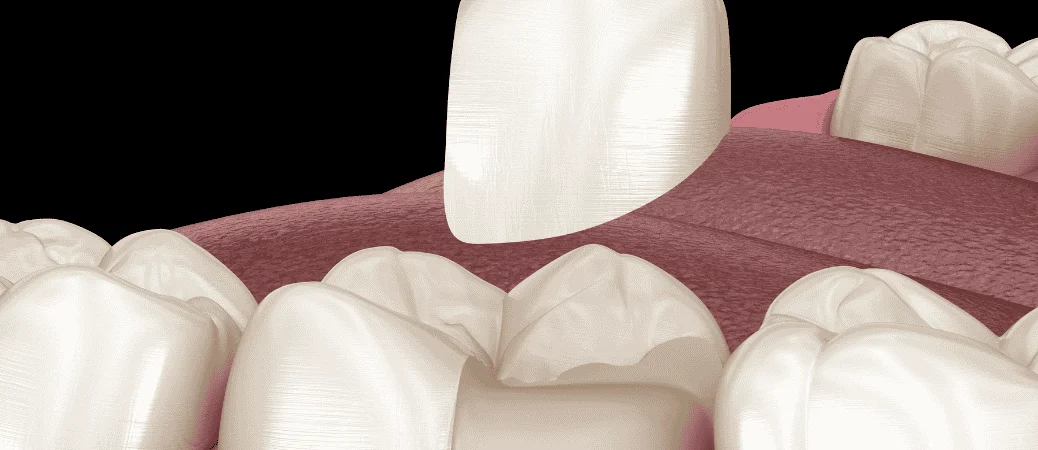
You went in for a small cavity and left with a question you did not expect: does this tooth need a filling, or something bigger? It is a common spot to be in, and the answer is not always obvious from an X-ray alone.
Dentists decide based on how much healthy tooth is left after the decay is removed, small cavities get a filling, moderate damage that leaves the cusps intact usually calls for an inlay or onlay, and a tooth with weak or broken cusps needs a crown for full coverage.
Long-term research links higher maximum bite force with more fractures of teeth and porcelain.
That middle ground matters more than most people realize. Inlays and onlays, sometimes called partial crowns, fill the gap when a cavity is too big for regular filling material but the tooth is still too healthy to shave down for a crown.
Below, we will walk through what your dentist checks, why your bite forces change the plan, and what each option, filling vs onlay vs crown, costs you in time, money, and natural tooth structure.
Key Takeaways
- Your dentist bases the choice on how much strong tooth remains, not just how big the cavity looks.
- Back teeth handle heavier chewing forces, so they often need more coverage than front teeth.
- Cracked cusps, root canals, and repeat repairs on the same tooth usually point toward a crown.
Table of Content
- The Quick Decision: Filling, Inlay, Onlay, or Crown
- What Dentists Evaluate After Removing Decay
- Why Bite Forces Change the Best Restoration
- Special Situations That Often Favor a Crown
- Treatment Process, Cost, and Long-Term Care
- Frequently Asked Questions
The Quick Decision: Filling, Inlay, Onlay, or Crown
The choice comes down to how much healthy tooth is left after the decay is cleaned out, and whether the cusps (the pointed chewing corners) can still handle biting pressure.
Small damage gets a filling, moderate damage gets an inlay or onlay, and a tooth that is cracked or mostly hollow gets a crown.
When a Filling Is Usually Enough
A filling is the first choice when the cavity is small and sits inside the tooth, with strong enamel walls all around it.
Your dentist cleans out the decay and packs the space with a filling material in one visit. Most back teeth today get a composite filling made of composite resin, which is bonded in place and matched to your tooth color.
Good signs a filling will work:
- The decay covers less than about a third of the chewing surface
- No cracks running through the cusps
- The tooth does not hurt when you bite down hard
- Enough enamel is left to support the edges of the repair
Fillings are suitable for minor tooth damage or early decay. Push a filling past its limits and the tooth can chip around it later.
When an Inlay May Be the Middle Option
An inlay is a custom-made piece that fits inside the cusps, filling the grooved center of a back tooth.
It is made outside your mouth, either in a dental lab or with a same-day milling machine, then bonded into the prepared space.
That lab-made fit is usually tighter and stronger than a large direct filling.
Your dentist may suggest one when the cavity is wide across the middle of a molar, but the cusps are still solid and unbroken.
Replacing a big, worn-out old filling is another common reason.
A dental inlay restores damage limited to the central area of the tooth. Cost usually lands between a filling and a full crown, which depends on the material and the tooth.
When an Onlay Protects a Weak Cusp
An onlay does everything an inlay does, then wraps over one or more cusps to shield them. People sometimes call it a partial crown.
This is the option when one corner of your molar has cracked off, or the decay has undermined a cusp so it could split under chewing force.
Covering that cusp spreads the bite pressure instead of letting it wedge the tooth apart.
Onlays are usually porcelain, composite resin, or gold. An inlay or onlay can provide more strength and stability when a cusp is weakened, while still keeping the healthy walls of your tooth untouched.
Preserving more of your natural tooth structure is the main advantage. Less drilling now means more healthy tooth remains if the tooth needs another repair years later.
When Full Crown Coverage Is the Safer Choice
A dental crown covers the whole tooth above the gumline, so the crack or weak spot cannot spread.
Your dentist will likely make a crown recommendation when:
- Very little natural tooth is left after the decay is removed
- A crack runs across the floor of the tooth or down toward the root
- The tooth had a root canal and needs full protection
- A huge old filling has failed and the walls are thin
- You grind your teeth and put heavy force on that spot
In the crown vs filling debate, dentists weigh tooth strength, symptoms, and X-rays before deciding.
A crown is often the safest long-term option once damage reaches that point, even though it means removing more structure than an onlay would.


What Dentists Evaluate After Removing Decay
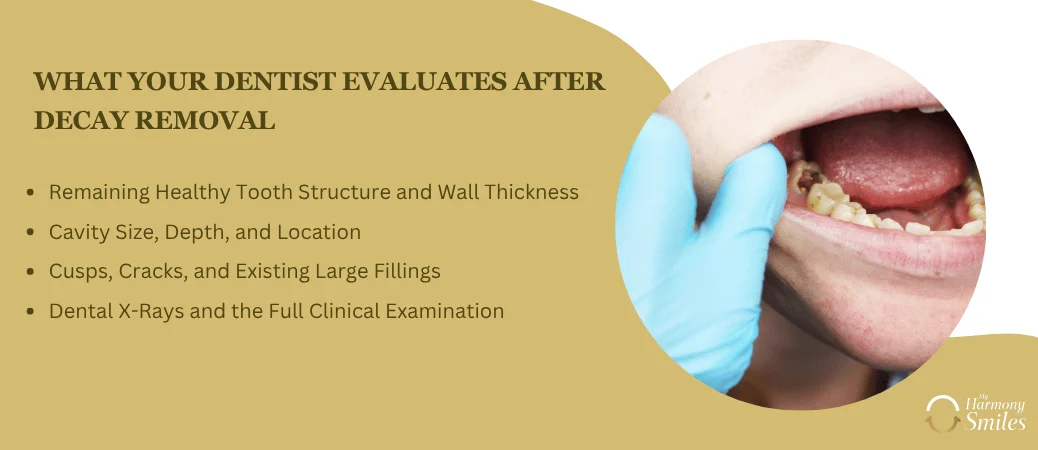
Your dentist often can’t make the final call until the decay is completely cleaned out. What’s left behind, the walls, the cusps, the enamel, and any hidden cracks, decides whether you get a filling, an onlay, or a full crown.
Remaining Healthy Tooth Structure and Wall Thickness
Once the soft, decayed material is gone, your dentist looks at how much solid tooth is still standing.
Thin or undermined walls are the biggest red flag. A filling needs strong tooth structure around it to hold up under chewing, and when the remaining tooth walls are thin, that filling can act like a wedge and push the tooth apart over time.
Here’s a question worth asking during your visit: how much healthy tooth structure will remain after the decay or old filling comes out? The answer usually points to the treatment.
- Thick, solid walls → a filling is often enough
- One weak wall, others strong → an onlay may cover just the damaged part
- Multiple thin walls → a crown wraps and holds the tooth together
Cavity Size, Depth, and Location
Size and spot on the tooth both matter. Dentists weigh the size of the cavity, the tooth’s location, and how much healthy structure survives the cleanout.
Small cavities that stay within the enamel and outer dentin are straightforward filling territory. Large cavities that spread across the chewing surface and down a side wall leave much less to work with.
Depth counts, too. When decay reaches close to the nerve, your dentist checks whether the pulp is still healthy before sealing anything permanently.
Location adds chewing force into the math. Molars take the heaviest pressure of any tooth in your mouth, so a wide cavity on a molar is more likely to need onlay or crown coverage than the same size cavity on a front tooth.
Cusps, Cracks, and Existing Large Fillings
Cusps are the pointed corners on your back teeth, and they take the brunt of every bite. Losing one changes the plan quickly.
A fractured cusp usually can’t be rebuilt with composite alone. That’s where an onlay shines, it replaces the missing cusp and caps it without covering the whole tooth.
Cracks push the decision toward more coverage. Pain when you bite or release pressure, on-and-off sensitivity, or visible fracture lines all suggest the tooth needs something that holds the pieces together.
Old work matters as well. If you already have a large filling with recurrent decay creeping around its edges, replacing it with another big filling often leaves too little support behind.
Dental X-Rays and the Full Clinical Examination
At My Harmony Smiles, Dr. Bibek Nakarmi can evaluate the remaining tooth structure, bite, X-rays, and extent of damage to determine whether a filling, onlay, or crown offers the right level of protection.
The hands-on exam fills in the rest. Your dentist checks your bite, taps and probes the tooth, tests sensitivity, and looks for stress lines in the enamel.
Bite marking paper shows where your teeth hit hardest. Heavy contact on a damaged tooth, or signs you grind at night, nudges the plan toward stronger coverage.
Together, these steps help your dentist decide whether the tooth can be saved with a conservative repair or needs full protection.
Why Bite Forces Change the Best Restoration
Where a tooth sits in your mouth changes how much pressure it takes every day, and that pressure helps your dentist pick between a filling, an onlay, or a crown. Grinding habits and worn enamel push that decision even further toward full coverage.
Why Molars and Premolars Need More Protection
Your front teeth mostly tear and cut food. Your molars and premolars crush it, so they absorb the highest chewing forces in your mouth.
Digital bite studies using T-Scan show that molars carry most of the load when you clench down hard. That matters when a cavity reaches into a cusp.
A large filling in a back tooth acts like a wedge. Each bite pushes the remaining walls outward, and thin walls can split.
So the deciding factor is usually structure, not just cavity size. Dentists often choose a filling when enough solid tooth remains to stay strong on its own, and move to an onlay or crown when the tooth needs reinforcement.
Here’s a simple way to think about it:
| Situation | Common choice |
| Small cavity, thick walls, no cracks | Filling |
| One or two weakened cusps, healthy walls elsewhere | Onlay |
| Multiple broken cusps or a cracked tooth | Crown |
How Grinding and Clenching Raise Fracture Risk
Bruxism means you grind or clench, often while you sleep. You may never notice it, but your teeth feel every bit of it.
Long-term research links higher maximum bite force with more fractures of teeth and porcelain. As bite force climbs, so does the chance something chips or cracks.
Worn teeth make this worse. When enamel flattens and contact points shrink, force concentrates on smaller spots instead of spreading out.
That’s why your dentist may recommend crown protection for a grinder, even when a smaller repair looks possible. Full coverage wraps the tooth and helps hold the cusps together.
Clues you might grind: morning jaw soreness, flat or shiny wear spots, tight temples, or chipped edges.
How a Nightguard Can Protect Restored Teeth
A nightguard is a custom plastic tray you wear while sleeping. It doesn’t stop clenching, but it takes the hit instead of your enamel and your new crown.
Cost matters here. Replacing a fractured crown costs far more than replacing a worn guard.
Fit matters too. A custom guard from your dentist spreads bite pressure evenly, while a bulky drugstore version can shift your bite and create new high spots.
Expect your dentist to check your bite after placing any restoration and adjust high contacts. A restoration that hits first takes extra force every single day.
Special Situations That Often Favor a Crown
Some teeth come with extra risk factors that make a filling or even an onlay a shaky bet.
Root canal treatment, old failing fillings, deep cracks, and missing walls all change how much support a tooth needs to survive normal chewing.
Teeth After Root Canal Treatment
After a root canal, your tooth is hollowed out from the inside. The access hole on top, plus the decay that caused the problem, removes a lot of the structure that once held the tooth together.
Back teeth handle the heaviest biting forces, so molars and premolars almost always get full coverage after treatment. A crown spreads the load across the whole tooth instead of letting it flex and split.
A post may be placed inside the root, but a post does not make the tooth stronger. It only helps hold a core buildup that replaces missing structure.
Front teeth are different. If the tooth is mostly intact and the color looks good, your dentist may seal the access hole with composite and skip the crown.
Large Failing Fillings and Recurrent Decay
Old fillings do not last forever. Margins wear down, tiny gaps form, and bacteria sneak underneath, which leads to recurrent decay that you often cannot see or feel.
Once your dentist removes that old filling and the new decay, the hole is usually bigger than before. Replacing it with an even larger filling can leave thin walls that weaken the tooth instead of supporting it.
Signs that point toward a crown or onlay:
- The filling covers most of the chewing surface
- Decay reaches below the gum line
- One or more cusps have no solid wall left
- The tooth has already been filled two or three times
Deep Cracks, Broken Cusps, and Core Buildups
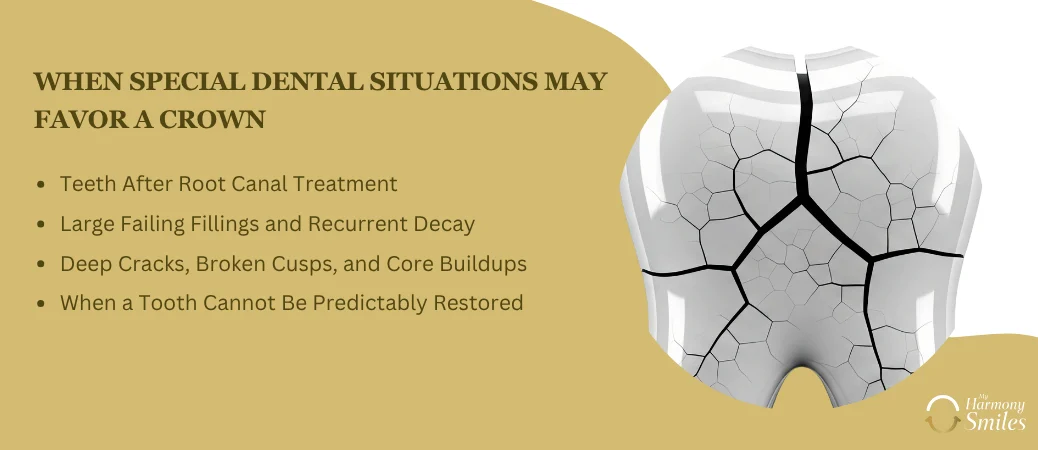
A cracked tooth behaves differently than a simple cavity. Each bite flexes the crack a little wider, and pain when you release your bite is a classic warning sign.
A filling sits inside the tooth and cannot hold the halves together. A crown or onlay wraps over the top, which limits that flexing and helps stop the crack from spreading.
A fractured cusp is similar. When a corner snaps off, cuspal coverage restores the shape and protects what is left.
If several walls are gone, your dentist first places a core buildup in bonded composite to rebuild a solid base. The crown then fits over that foundation.
When a Tooth Cannot Be Predictably Restored
Sometimes a crown is not enough, and it helps to know that ahead of time. Your dentist looks for whether there is a healthy band of tooth structure above the gum to grip, called a ferrule.
Situations that may lead to tooth extraction instead:
| Finding | Why it matters |
| Crack running into the root | Cannot be sealed or covered |
| Decay far below the gum | No solid margin for the crown |
| Very little tooth above the gum | Crown has nothing to hold onto |
| Severe bone loss around the tooth | Support is already gone |
In borderline cases, crown lengthening or slowly moving the tooth upward with orthodontics can create a better foundation.
Treatment Process, Cost, and Long-Term Care
Each option takes a different amount of chair time, costs a different amount, and asks something different of you afterward.
Knowing what happens at each visit, and what keeps the repair working for years, makes the choice a lot less stressful.
What to Expect During Filling, Onlay, and Crown Treatment
A dental filling is usually a single visit. Your dentist numbs the area, removes the decay, and packs tooth-colored composite into the space. It hardens under a curing light, and you leave with a finished tooth.
An onlay and a dental crown both need the tooth shaped first. The difference is how much shaping happens.
- Onlay: only the damaged cusps are reduced. Your healthy walls stay put, which supports tooth preservation and conservative dentistry.
- Crown: the whole outer surface is trimmed down so the cap fits over it.
Both are made outside your mouth, then bonded or cemented on. Some offices mill them in-house the same day. Others send the work to a lab, which means two visits.
Temporary Crowns and Final Restoration Placement
If your office uses a lab, you go home with a temporary crown for about two to three weeks. It is made of acrylic and held on with soft cement, so treat it gently.
A few habits help:
- Skip sticky candy, caramel, and chewing gum on that side.
- Slide floss out sideways instead of snapping it up.
- Chew on the other side when you can.
At the second visit, your dentist takes the temporary off, tries in the final piece, and checks the fit, color, and bite. You will be asked to tap and grind lightly so high spots can be smoothed down.
Then it gets cemented for good. Cold sensitivity for a week or two is common and usually fades.
Comparing Crown Cost With the Cost of Repeat Repairs
Costs vary by region, material, and insurance, but the order rarely changes. Fillings cost the least, onlays and inlays sit in the middle, and crowns cost the most.
| Restoration | Typical visits | Relative cost | Tooth removed |
| Filling | 1 | Lowest | Very little |
| Onlay | 1–2 | Middle | Damaged cusps only |
| Crown | 1–2 | Highest | Full outer surface |
Here is the part worth thinking about. A cheap filling that fails in two years often gets replaced by a bigger filling, then an onlay or crown anyway.
Oral Hygiene Habits That Help Restorations Last

Good oral hygiene matters more after a big restoration, not less. Decay does not attack the porcelain or composite, it attacks the tooth right at the edge of it.
- Brush twice a day with fluoride toothpaste, angling the bristles toward the gumline.
- Clean between teeth daily with floss or an interdental brush, especially around crown margins.
- Cut back on sipping sweet drinks throughout the day.
- Wear a night guard if you grind, since grinding cracks both natural teeth and restorations.
- Keep your checkups so leaking edges get caught early.
Well-cared-for crowns and onlays often last 10 to 15 years or longer. Fillings usually have a shorter run.
Symptoms That Need Prompt Dental Care
Contact your dentist if you notice any of these:
- Pain when you bite down, or a sharp jolt when you release
- A rough edge, a chip, or a filling that has fallen out
- Food packing in the same spot every day
- New sensitivity to cold that does not settle
- A crown that feels loose or rocks slightly
Some things should not wait. Facial swelling, severe pain that starts on its own, or a break with a pink or red spot in the middle of it means emergency care is needed.
Catching a problem early often means a smaller fix. Waiting usually means a bigger one.
Frequently Asked Questions
Dentists look at how much healthy tooth is left, where the damage sits, and whether the tooth can handle chewing pressure before picking a filling, an onlay, or a crown.
Below are answers to the questions patients ask most when a cavity turns out to be bigger than expected.
How do dentists decide whether a cavity needs a filling, an onlay, or a crown?
Your dentist checks the size of the decay, the strength of the walls around it, and what the X-ray shows below the surface. Symptoms matter too, like pain when you bite down or sensitivity that lingers.
A filling is usually the pick when the decay is moderate and at least one strong wall of the tooth is still solid. Once too much of that wall is gone, the tooth needs something that wraps over the top instead of sitting inside it.
Payment and financing options play a role in the plan as well. Many dentists walk you through tooth strength, X-rays, materials, and insurance coverage before you agree to treatment.
How large can a cavity be before a filling is no longer the best option?
There is no exact measurement that works for every tooth, but many dentists use a rough guide often called the 50% rule. If the damage covers about half of the tooth’s chewing surface or more, a filling starts to lose its advantage.
The reason is simple: a large filling needs the tooth around it to do the heavy lifting. When too little tooth is left, that support is gone.
Back teeth also take more force than front teeth. A cavity that would be fine to fill on a front tooth may need extra reinforcement on a molar.
What is the difference between a dental filling, an onlay, and a crown?
Think of them as three levels of coverage:
- Filling: Material is packed into the space where decay was removed. The rest of the tooth stays untouched.
- Onlay: A custom-made piece covers one or more cusps, the raised points on the chewing surface. It is sometimes called a partial crown.
- Crown: A cap covers the whole tooth down to the gumline.
An onlay covers only the damaged part of the tooth, while a crown covers all of it.
Inlays fit in the same family, sitting between the cusps rather than over them, and comparing inlays, onlays, and crowns side by side can help you follow your dentist’s reasoning.
Can a large filling weaken a tooth over time?
Yes, it can. Every time you chew, the filling pushes outward against the thin walls of tooth around it.
Over years, those walls can flex and develop small cracks. That is why dentists watch big fillings closely and sometimes suggest replacing one before it fails.
Grinding your teeth speeds this up. So does chewing ice, hard candy, or anything else that puts sudden pressure on the same spot.
Is an onlay a more conservative alternative to a crown?
In most cases, yes. An onlay keeps more of your natural tooth because the dentist does not shave the whole thing down.
It works well when the tooth is too damaged for a filling but still has enough healthy structure to skip full coverage. If the tooth is badly cracked or weak all the way around, a crown is the safer choice.
Both options last a similar amount of time. Onlays and crowns are typically designed to last 5 to 15 years, depending on your habits and how well you care for them.
What happens if a tooth with a very large cavity is treated with only a filling?
The filling may hold up fine for a while. But the risk of a fracture goes up, and cracks in back teeth often run below the gumline where they are hard to repair.
If a cusp breaks off, you may end up needing a crown anyway. In some cases, a crack reaches the nerve and a root canal gets added to the plan.
That is why it helps to look at the full range of restoration options and their costs up front. Paying a bit more now can be cheaper than treating a broken tooth later.