


Deciding to straighten your teeth is a big step toward a healthier, more confident smile. But once you have made that decision, you face another important choice: should you choose Invisalign vs traditional braces?
Both options are highly effective at correcting crooked teeth, closing gaps, and fixing bite issues. However, they work in very different ways and fit into your daily life quite differently.
If you are an adult professional who wants a discreet treatment, an active teen who plays sports, or a parent looking for the best option for your child, finding the right fit depends on your unique needs.
This detailed guide compares Invisalign vs traditional braces across all the factors that matter most. You will learn how each treatment works, how long they take, what they cost, and which one is better for your specific dental situation.
By the end, you will have all the information you need to make a confident choice.
How Invisalign Works
Invisalign uses a series of custom-made, clear plastic aligners to gradually move your teeth into their desired positions. The process begins with a digital 3D scan of your teeth.
Using advanced computer software, your orthodontist maps out every stage of your tooth movement before you even start treatment. You can even see a virtual preview of your new smile.
Each set of aligners is worn for about one to two weeks, typically for 20 to 22 hours per day. You remove them only to eat, drink anything other than water, brush, and floss.
Over time, each new aligner applies gentle pressure to shift your teeth slightly. Mild to moderate cases are usually completed in 6 to 18 months, while more complex plans may take longer.
How Traditional Braces Work
Traditional braces use a system of metal brackets bonded to the front of your teeth, connected by archwires.
The wires are periodically tightened by your orthodontist, which applies continuous pressure to move your teeth into alignment. Elastic bands are often added to correct bite issues.
Braces work 24 hours a day, seven days a week, because they are fixed to your teeth. You cannot remove them yourself.
Treatment typically lasts 12 to 24 months, with adjustments scheduled every 4 to 6 weeks. While metal braces are the most common, ceramic braces use tooth-colored brackets for a less visible appearance.
Comparison: Invisalign vs Traditional Braces
| Feature | Invisalign | Traditional Braces |
| Appearance | Virtually invisible, clear plastic aligners | Noticeable metal brackets and wires (ceramic options available) |
| Comfort | Smooth plastic with no sharp edges | Brackets and wires can irritate cheeks and lips |
| Removability | Removable for eating, drinking, and cleaning | Fixed to teeth for the entire treatment duration |
| Oral Hygiene | Remove aligners to brush and floss normally | Requires special brushes, floss threaders, and more time |
| Food Restrictions | None (remove aligners before eating) | Must avoid hard, sticky, and chewy foods |
| Appointment Frequency | Every 6 to 8 weeks for monitoring | Every 4 to 6 weeks for adjustments |
| Best For | Mild to moderate cases | All cases, including complex issues |
| Compliance Required | High – must wear 20-22 hours daily | Low – braces work automatically |
| Cost Range ($) | 3,000–3,000–8,000 | 3,000–3,000–8,000 |
Aesthetics: Which Treatment Is Less Noticeable?
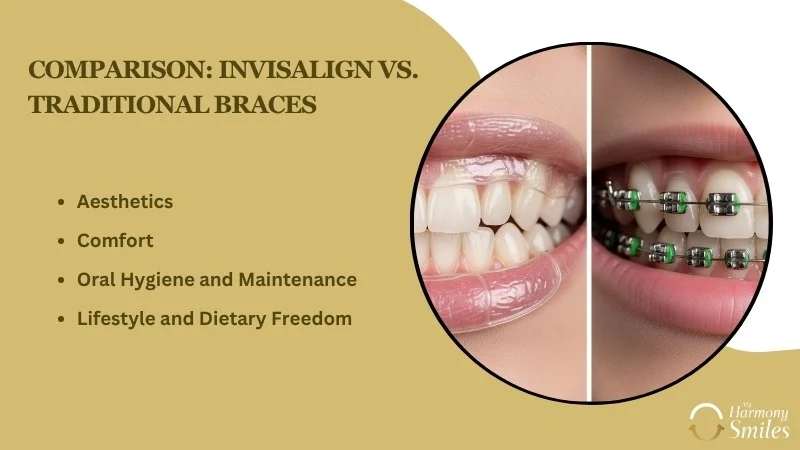
For many adults and image-conscious teens, the appearance of orthodontic treatment is a top concern. Invisalign vs traditional braces is not a close contest here.
Invisalign aligners are made of clear, smooth plastic and are virtually invisible at a conversational distance. Most people will not notice you are wearing them unless you tell them.
Traditional metal braces are much more noticeable. The brackets and wires are clearly visible when you talk or smile. This can make some patients feel self-conscious, particularly in professional or social settings.
However, ceramic braces use tooth-colored or clear brackets that blend in with your teeth, offering a less visible alternative to metal braces.
Lingual braces, which are placed behind the teeth, are completely hidden but tend to be more expensive and less comfortable.
Comfort: Which Feels Better Day to Day?
Braces use metal brackets and wires to move your teeth. The brackets can rub against the inside of your cheeks and lips, causing irritation and sometimes even sores.
Wires may poke or feel uncomfortable, especially after adjustment appointments. Patients often use orthodontic wax to cover sharp spots.
Invisalign aligners are made of smooth, medical-grade plastic. Because they have no brackets or wires, there is nothing to irritate your mouth.
You may feel some pressure or tenderness when you start a new set of aligners, but this typically fades after a day or two. Most patients find Invisalign significantly more comfortable to wear than traditional braces.
Oral Hygiene and Maintenance
Keeping your teeth clean during orthodontic treatment is essential to avoid cavities, gum disease, and white spots on your teeth.
With braces, oral hygiene becomes much more challenging. Food can easily get trapped around brackets and under wires. You must brush carefully after every meal and floss using special tools like floss threaders or interdental brushes.
Cleaning your teeth with braces typically takes much longer than normal brushing.
With Invisalign, you simply remove your aligners to brush and floss exactly as you normally would. There are no brackets or wires to navigate around. Your aligners themselves require daily cleaning with a soft toothbrush and clear, mild soap.
Never use toothpaste on your aligners, as it can scratch them. You also need to rinse your aligners every time you remove them.
Lifestyle and Dietary Freedom
Your lifestyle plays a major role in choosing between Invisalign vs traditional braces.
With traditional braces, you must avoid many foods to protect your appliance. Hard, sticky, and chewy foods can break brackets, bend wires, or get painfully stuck. Foods to avoid include:
- Nuts, popcorn, chips, and ice
- Caramel, taffy, and other sticky candies
- Corn on the cob, whole apples, and raw carrots
- Chewing gum, bagels, and tough crusts
With Invisalign, you have no dietary restrictions. You simply remove your aligners before eating or drinking anything other than water. You can enjoy all your favorite foods without worry.
However, you do need to brush your teeth before putting your aligners back in, which may affect spontaneous snacking.
For athletes and musicians, Invisalign offers clear advantages. Contact sport athletes can remove their aligners during games or wear a mouthguard over them.
Musicians who play wind instruments often find that braces interfere with their embouchure. Invisalign can be removed for performances, eliminating that problem.
Effectiveness for Complex Dental Issues
When it comes to Invisalign vs traditional braces, which is better for complex cases, traditional braces remain the gold standard. Braces offer precise control over tooth movement, including vertical shifts, rotations, and significant bite corrections. They are ideal for:
- Severe crowding or spacing
- Major rotations (e.g., turning a tooth 90 degrees or more)
- Complex bite problems like overbites, underbites, and crossbites
- Cases requiring the extraction of teeth
- Significant vertical tooth movement
Invisalign is highly effective for mild to moderate alignment issues. It works well for:
- Minor crowding or spacing
- Mild to moderate overbites and underbites
- Relapse after previous orthodontic treatment
- Patients who have had braces before and want to correct minor shifting
However, Invisalign has limitations. It may not be suitable for severe tooth rotations, complex bite corrections, or cases requiring significant vertical tooth movement. Your orthodontist will determine whether your specific case can be effectively treated with clear aligners.
A 2024 study in the Journal of Pharmacy and Bioallied Sciences found that both traditional braces and Invisalign effectively improved dental alignment and occlusal stability over a 5-year follow-up period. Importantly, patient satisfaction scores were consistently higher in the Invisalign group compared to traditional braces.
Cost: How Much Is Invisalign vs Braces?
When comparing the costs of Invisalign vs braces, the cost ranges overlap significantly. In the United States, as of 2026, both options typically range from $3,000 to $8,000.
Traditional metal braces are often on the lower end of this range ($3,000 to $7,000), while Invisalign may range from $3,500 to $8,000 depending on case complexity.
Several factors influence the final price of both treatments:
- The complexity and duration of your case
- Your geographic location
- The experience and expertise of your orthodontist
- Whether your insurance plan covers orthodontic treatment
Many dental insurance plans now cover both Invisalign and traditional braces at similar rates. The cost gap between the two options has narrowed significantly over the past five years.
Both treatments often offer flexible payment plans, allowing you to spread the cost over several months or years. Your orthodontist can provide a detailed estimate after your initial consultation.
Appointment Frequency and Treatment Time
Braces require more frequent office visits. You typically need adjustments every 4 to 6 weeks. During these appointments, your orthodontist tightens the wires, changes elastics, and monitors your progress. Each adjustment may cause temporary soreness for a day or two.
Invisalign requires fewer visits, typically every 6 to 8 weeks. These appointments are generally shorter, as your orthodontist simply checks that your teeth are moving as planned and provides you with the next set of aligners. There is no tightening involved, and the appointments are far less intense.
Invisalign vs braces which is faster depends entirely on your specific case. For mild to moderate corrections, Invisalign may finish faster, often in 6 to 12 months for simple spacing issues. For complex cases, braces may be more efficient and predictable.
| Case Type | Braces | Invisalign |
| Mild spacing (6-12 months) | 12-18 months | 6-12 months |
| Moderate crowding (12-18 months) | 12-18 months | 12-18 months |
| Severe complex cases (18-24+ months) | 18-24 months | 18-36 months |
When Braces Are a Better Option

While Invisalign offers many advantages for the right patient, traditional braces are still the better choice for certain situations.
- Severe crowding or spacing: If your teeth are severely crowded or have large gaps, braces provide the force and control needed to move them effectively.
- Complex bite issues: Open bites, deep overbites, underbites, and crossbites often require the precise control that only braces can provide.
- Rotated teeth: Major tooth rotations (turning a tooth more than 20 degrees) are challenging for clear aligners but simple with braces.
- Young children and teens who may not comply with aligner wear: Braces work automatically. For patients who may forget to wear their aligners or lose them, braces ensure treatment stays on track.
- Extraction cases: When teeth need to be removed to create space, braces offer better control over closing the gaps.
Your orthodontist will evaluate your specific dental condition and recommend the most effective treatment option for your needs.
Decision Guide: How to Choose the Right Treatment for You
Still unsure which path is right for you? Answer these questions to help guide your decision.
Choose Invisalign if:
- You want a nearly invisible treatment that fits discreetly into your professional and social life.
- You have mild to moderate crowding, spacing, or bite issues.
- You are committed to wearing your aligners 20 to 22 hours per day.
- You want the freedom to eat whatever you like and remove your appliance for special events.
- You prefer fewer orthodontic appointments.
- You want easier oral hygiene without navigating around brackets and wires.
Choose Traditional Braces if:
- You have complex orthodontic issues like severe crowding, large rotations, or significant bite problems.
- You do not want to worry about compliance or remembering to wear an appliance.
- You are a younger patient or parent who prefers a treatment that works automatically.
- You need a more affordable option for complex treatment.
- You prefer not to remove and reinsert an appliance throughout the day.
Most importantly, schedule a consultation with an experienced orthodontist. Only a thorough in-person examination, including X-rays and digital scans, can determine which treatment is best for your unique smile.
Frequently Asked Questions About Invisalign vs Traditional Braces
Is Invisalign more expensive than braces?
Invisalign can be slightly more expensive, but costs overlap significantly. Both typically range from $3,000 to $8,000 in the U.S. as of 2026. Your insurance coverage and case complexity will determine the final price.
Which treatment is faster?
For mild to moderate corrections, Invisalign may be faster (6-12 months). For complex cases, braces are often more efficient and predictable. Treatment duration depends more on case complexity than the method itself.
Do braces hurt more than Invisalign?
Braces tend to cause more irritation and soreness, particularly after adjustment appointments. Invisalign causes pressure when starting new aligners, but most patients find it more comfortable overall.
Can I switch from Invisalign to braces?
Yes, some patients start with Invisalign and later switch to braces if their teeth are not moving as planned. Your orthodontist will discuss this possibility during treatment.
How do I clean my aligners?
Rinse your aligners with lukewarm water every time you remove them. Brush them gently with a soft toothbrush and clear, mild soap. Never use toothpaste, as it can scratch the plastic and make your aligners visible.
What foods can I eat with braces?
Avoid hard, sticky, and chewy foods that can damage brackets and wires. Stick to soft foods like yogurt, pasta, soup, and cut fruits. Avoid nuts, popcorn, caramels, and chewing gum.
Conclusion
Choosing between Invisalign vs traditional braces is a personal decision that depends on your dental needs, lifestyle, budget, and goals.
Both treatments have successfully straightened millions of smiles. The best choice is the one that fits your unique situation.
If you value discretion, comfort, and the freedom to remove your appliance, comparing Invisalign vs. traditional braces, you may lean toward Invisalign.
If you have complex orthodontic needs or prefer a treatment that works automatically without daily compliance decisions, traditional braces are likely your better option.
The most important step is to schedule a consultation with an experienced orthodontist.
At My Harmony Smiles, we offer personalized treatment planning and flexible payment options to help you achieve the smile you have always wanted.