

You chose Invisalign because you wanted a simple way to straighten your teeth. In many cases, it works well. But sometimes clear aligners cannot fix deeper bite problems, severe crowding, or jaw issues on their own.
If your teeth still shift, your bite feels off, or your results stall, you may need more than Invisalign alone. You might need refinements, attachments, rubber bands, or even a more comprehensive plan that uses braces or other tools.
These options can give your dentist more control over complex tooth movement.
When you know the warning signs early, you can act fast and protect your progress. Understanding when Invisalign is not enough helps you avoid frustration and get the healthy, stable smile you want.
Key Takeaways
- Clear aligners may not correct severe bite or alignment problems on their own.
- Ongoing shifting, discomfort, or poor fit can signal the need for added treatment.
- Early evaluation helps you adjust your plan and protect your long-term results.
Key Limitations of Invisalign
Invisalign works well for many mild to moderate cases, but it has clear limits. Severe bite problems, major crowding, large gaps, and complex tooth movements often need more than removable aligners.
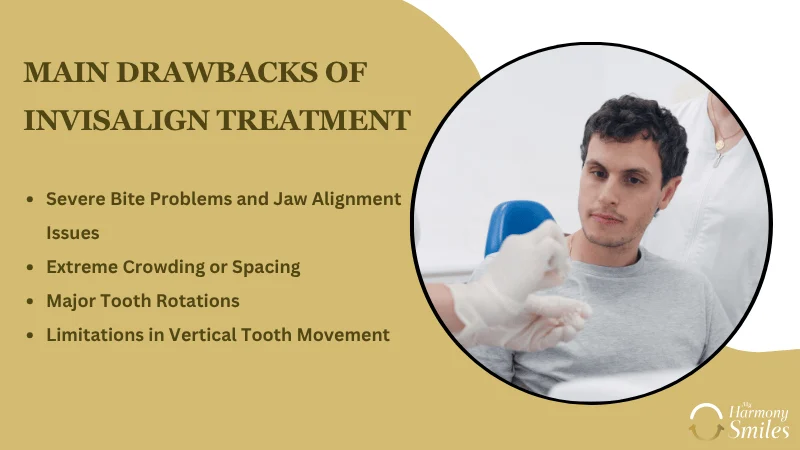
Severe Bite Problems and Jaw Alignment Issues
If you have a severe overbite, underbite, crossbite, or open bite, clear aligners may not give you full correction. Invisalign can improve mild to moderate bite issues, but large jaw shifts are harder to control with plastic trays alone.
Aligners apply steady pressure to your teeth. They do not directly move your jaw bones. When jaw alignment issues are the main cause of your bite problem, you may need braces, rubber bands, or even jaw surgery as part of comprehensive orthodontic treatment.
For example, a deep overbite greater than 5 mm or a strong underbite caused by lower jaw growth often needs fixed braces for better force control.
Some cases also require extra tools like elastics attached to brackets, which work more predictably than aligners alone.
If your bite affects chewing, speech, or causes jaw pain, your orthodontist may suggest a treatment plan beyond Invisalign.
Extreme Crowding or Spacing
Mild crowding or small gaps between teeth often respond well to aligners. But extreme crowding or wide spacing can push Invisalign past its limits.
When teeth overlap heavily, your orthodontist may need to create space first. This could involve removing teeth or reshaping enamel. In cases where gaps are larger than 6 mm, aligners may struggle to close them fully without extra support.
Fixed braces allow more precise root movement in tight spaces. They also give stronger control when pulling teeth together across large gaps.
If your teeth are severely packed or widely spaced, comprehensive orthodontic treatment may give you more stable results.
Major Tooth Rotations
Teeth that are rotated more than 45 degrees can be difficult to correct with aligners alone. Invisalign trays grip the visible part of your tooth, but large rotations require strong control at the root level.
Small attachments bonded to your teeth help aligners hold better. Even so, major rotation may not fully respond, especially with round teeth like canines or premolars.
Braces use brackets and wires to apply force from different angles. This setup gives your orthodontist more control over complex rotation. If you have a tooth that looks twisted far out of place, braces may move it more predictably.
In some cases, your provider may start with braces to correct rotation, then switch you to Invisalign for finishing.
Limitations in Vertical Tooth Movement
Vertical tooth movement means moving a tooth up or down in the bone. This type of shift is harder for clear aligners to control.
For example, closing a large open bite often requires teeth to move vertically. Aligners can improve mild open bites, but larger ones may need braces with elastics for better force direction.
Extruding a tooth, or pulling it downward, can also be less predictable with trays. Braces anchor more firmly to each tooth, which helps guide these movements.
If your treatment plan includes major vertical correction, your orthodontist may recommend a combination approach. That plan gives you better control over both tooth position and bite alignment.
Signs Invisalign May Not Be Enough
You may notice that your teeth are not moving as planned, even after wearing aligners as directed. Some problems need more force, better control, or a different approach than clear trays can provide.
Persistent Gaps or Overlapping Teeth
If you still see gaps between teeth or heavy overlapping after several aligner changes, your case may need more than clear trays. Small spaces often close well with aligners, but wide gaps can resist movement.
Teeth that sit far outside the dental arch or are severely rotated may not respond fully. In some cases, aligners cannot create enough force to turn or pull these teeth into place.
Dentists note that very rotated or displaced teeth may respond better to braces.
Impacted teeth also limit progress. If a tooth remains stuck under the gums, aligners alone cannot guide it into position. You may need surgical exposure and braces to support proper teeth straightening.
Unresolved Bite Problems
Clear aligners can fix mild bite issues, but complex cases often need comprehensive treatment. If your overbite, underbite, or crossbite remains after months of wear, the trays may not control jaw position well enough.
You might feel uneven pressure when you chew. Your front teeth may still hit too hard, or your back teeth may not touch at all. These signs suggest your bite needs stronger correction.
Severe bite problems often involve jaw alignment, not just tooth position. In these cases, braces, elastics, or even jaw-focused treatment may provide better control. If your aligners stop fitting well or do not fully seat on your teeth.
Improper Midline Alignment
Your dental midline is the line between your two front teeth. It should line up with the center of your upper lip and face.
If your midline remains off after several aligners, you may need more precise control than trays can provide. Midline correction often requires targeted force on specific teeth.
Aligners sometimes struggle to shift the entire arch sideways in a controlled way.
You may notice that one side of your smile looks higher or more crowded. This imbalance can affect both appearance and bite.
Braces allow orthodontists to fine-tune tooth position with wires and brackets. That added control can make a difference when your midline needs careful adjustment.
Recurring Tooth Shifting
If your teeth move into place but then shift back, something may be missing in your treatment plan. You might see spaces reopen or notice crowding return between aligner sets.
Inconsistent wear is one cause. Aligners must stay in for 20–22 hours a day to work as designed. When trays feel loose or stop tracking, teeth may not follow the planned movement.
Sometimes the issue goes deeper. Weak bone support, untreated bite problems, or incomplete correction can allow teeth to drift. In these cases, you may need braces, longer treatment, or added retention to keep your results stable.
Schedule your consultation today to see if Invisalign is right for your case.
Understanding When Refinements Are Needed
Sometimes your first set of trays does not finish the job. Teeth may not move as planned, or your bite may still feel off.
Refinements give your orthodontist a way to adjust your plan and improve the final result in the form of a complete smile makeover.
Indications for Invisalign Refinements
You may need Invisalign refinements if certain teeth stop tracking with your trays. If an aligner feels loose in one area or does not fully seat, that tooth may not be moving as expected.
Gaps that stay open, crowding that remains, or a bite that still feels uneven are common signs. You may also notice that your midline looks slightly off or your back teeth do not touch correctly.
Some cases require refinements to fix overcorrection or undercorrection. Overcorrection means a tooth moved too far. Undercorrection means it did not move enough.
Process of Getting Refinements
Your orthodontist starts by checking your progress. If your teeth have not reached the planned position, they will recommend an Invisalign refinement.
You will get new digital scans instead of messy impressions. The lab then creates new aligners that target the teeth that need more movement.
You may also need new attachments or buttons. These small tooth-colored bumps help the trays grip your teeth and guide precise movement.
The wear schedule usually stays the same. You wear the trays 20 to 22 hours a day and switch them every one to two weeks.
Refinements can last a few weeks or several months. The length depends on how much correction you still need.
Factors Impacting the Need for Refinements
Several factors affect how many refinements with Invisalign you may need.
The first is compliance. If you do not wear your aligners for at least 20 to 22 hours a day, teeth may fall behind schedule. Missed wear time often leads to extra trays.
The second factor is case complexity. Severe crowding, bite problems, or rotated teeth increase the chance of needing Invisalign refinements.
Your body also plays a role. Some teeth move slower than others, even when you follow instructions.
Cost varies by treatment plan. In many comprehensive cases, the Invisalign refinement cost is included in your original fee. Simpler plans, such as Lite or Express, may limit the number of refinement sets.
Clear communication with your orthodontist helps you understand your options and avoid surprises.
When to Consider Comprehensive or Hybrid Treatment
If your teeth or bite need more control than clear aligners can provide, you may need a stronger plan. Some cases call for traditional braces, a mix of braces and aligners, or even surgery.
Switching to Traditional Braces

You may need traditional braces if your teeth are very crowded, rotated, or far out of place. Clear aligners can fix many problems, but they may struggle with large tooth movements or major bite changes.
Metal brackets attach to each tooth and connect with a wire. Your orthodontist adjusts the wire to guide your teeth with steady pressure. This system gives more control than most invisible braces.
Dentists often recommend braces for complex cases. For example, invisalign may be recommended for extremely crowded or crooked teeth, but even that has limits.
If aligners do not track well or teeth stop moving as planned, braces can take over and keep treatment on schedule.
Braces also help when you have large gaps, severe overbite, underbite, or crossbite. In these cases, fixed appliances can move teeth and adjust your bite more predictably.
Combining Braces With Aligners
You do not always have to choose one or the other. Hybrid orthodontic treatment uses braces first, then switches to aligners for detail work.
Many orthodontists start with braces to correct major alignment or bite issues. After your teeth move into better positions, you transition to clear aligners to fine-tune the final results. This plan blends strength and flexibility.
This approach can shorten treatment time in some cases. It also lets you spend less time wearing visible metal brackets.
You may consider this option if you want better control at the start but prefer removable aligners later. It works well for teens and adults who want a balance between function and appearance.
When Surgery May Be Necessary
Sometimes orthodontic treatment alone cannot fix the problem. If your upper and lower jaws do not line up correctly, moving teeth may not be enough.
Jaw surgery, also called orthognathic surgery, corrects severe bite issues such as a strong underbite or overbite caused by bone position. Braces usually come before and after surgery to prepare your teeth and finish alignment.
Your orthodontist and an oral surgeon will review X-rays and 3D scans. They look at jaw size, position, and how your teeth fit together.
You may need surgery if you have trouble chewing, speaking, or closing your mouth comfortably. In these cases, surgery improves function first, and appearance follows as a result of better alignment.
Evaluating Your Treatment Progress
You need clear proof that your teeth are moving the right way. Careful tracking, detailed treatment planning, and regular check-ins help you see whether Invisalign is enough or if you need more advanced care.
Monitoring With Digital Scans and Technology
Your progress should not rely on guesswork. Modern offices use digital scans instead of messy molds to track tooth movement with precision.
An iTero scanner creates a 3D image of your teeth in minutes. Your Invisalign dentist can compare new scans to your original records and see if each tooth follows the planned path. Even small gaps between your aligner and teeth can signal that something is off.
Digital scans also show whether your bite is improving. If your upper and lower teeth still do not meet correctly, that may mean aligners alone cannot fix the issue.
Some offices also simulate expected results. When real progress does not match the digital plan, your dentist may adjust trays, add attachments, or recommend a more comprehensive option.
Role of the Invisalign Dentist and Treatment Planning
Your Invisalign dentist plays a direct role in whether treatment succeeds. Strong treatment planning makes the difference between minor cosmetic fixes and full bite correction.
During planning, your dentist studies your scans, X-rays, and bite alignment. They decide how each tooth should move and in what order. If your case involves jaw imbalance, severe crowding, or large gaps, aligners may not provide enough force.
You should also discuss goals clearly. Straight teeth do not always mean a healthy bite. If you still feel jaw strain or uneven pressure, your plan may need changes.
Many offices offer a complimentary consultation to evaluate signs Invisalign is working. Use that visit to ask direct questions about limits and next steps.
Importance of Follow-Up Consultations
Regular follow-up visits protect your results. Skipping appointments increases the risk of delays or missed problems.
Most patients return every 6 to 8 weeks. At each visit, your dentist checks aligner fit, attachment stability, and bite contact. If trays feel loose or stop seating fully, that signals tracking problems.
Consistent reviews also allow mid-course corrections. Your dentist may order refinement trays or recommend braces if teeth stop responding as planned.
You should report discomfort that lasts longer than a few days. Mild pressure is normal. Ongoing pain, shifting bite pressure, or visible gaps between aligners and teeth deserve attention right away.
Maintaining Oral Health and Hygiene Post-Treatment
After Invisalign, your teeth may look straighter, but they still need support and care. If alignment or bite issues remain, daily oral hygiene can become harder and may raise your risk for dental problems.
Oral Hygiene Challenges After Invisalign
You may expect brushing and flossing to feel easy once treatment ends. But if teeth did not fully align, tight spaces or uneven edges can trap plaque.
Crowded or slightly rotated teeth create spots your toothbrush cannot reach well. This makes oral hygiene less effective, even if you brush twice a day.
You might also struggle to floss between teeth that overlap. When floss shreds or will not pass through, plaque can build up and irritate your gums.
Wearing a retainer adds another step. Many dentists stress the need for proper cleaning and retainer care after treatment.
If cleaning feels harder than it should, your alignment may need more work. A small correction can make daily care easier and protect your teeth long term.
Risks of Incomplete Orthodontic Correction
When Invisalign does not fully fix your bite, problems can continue under the surface. You may notice chewing feels uneven or certain teeth hit first when you close your mouth.
An improper bite can place extra force on specific teeth. Over time, this may lead to enamel wear, small chips, or jaw soreness.
Teeth that shift back after treatment also raise concern. Relapse often signals that your teeth need more support or a different approach. Dentists warn that signs like persistent gaps, shifting teeth, or bite problems may mean you need more care.
If you ignore these issues, plaque can collect in open spaces. This increases your risk of cavities and gum disease.
Addressing incomplete correction early helps you protect both your smile and your overall oral health.
Frequently Asked Questions
You may notice slow tooth movement, bite problems, or trays that no longer fit well. These issues can point to the need for refinements or a more detailed treatment plan.
What are the signs that Invisalign treatment might not be working as expected?
You might see little or no movement after several tray changes. Your aligners may feel loose, or they may not fully seat on your teeth.
Your bite may also feel off. For example, your front teeth may hit before your back teeth, or you may still see crowding or gaps that have not improved.
If you often remove your trays for long periods, this can delay progress. Many providers explain in their Invisalign frequently asked questions that you need to wear aligners about 20 to 22 hours a day for proper results.
Can you describe the Invisalign refinement process and when it’s typically necessary?
Refinement means you receive new scans and extra trays after your first set ends. Your provider adjusts the plan to fix areas that did not move as expected.
You may need refinements if small gaps remain or if your bite still needs correction. Some patients also need attachments repositioned to improve control.
Refinements are common and do not mean your treatment failed. They help fine-tune your results.
How can one identify the need for a more comprehensive treatment after using Invisalign?
You may need more than aligners if you have severe crowding, large jaw differences, or major bite problems. Invisalign can correct many mild to moderate issues, but complex cases may need braces or other tools.
Some orthodontists explain in guides on common questions and concerns around Invisalign that severe misalignment may require added treatment steps.
If your teeth look straighter but your bite still feels unstable, you may need a broader plan.
What should I do if I notice minimal results after completing my initial Invisalign treatment?
Schedule a visit with your orthodontist right away. Ask for a full exam, new scans, and a clear review of your progress.
Your provider may suggest refinements, additional attachments, or even a short phase of braces. Do not stop wearing your aligners or retainers unless your provider tells you to.
Acting early can prevent your teeth from shifting back.
What are some common indicators that additional orthodontic treatment may be required beyond Invisalign?
You may still have jaw pain, uneven tooth wear, or speech changes after treatment. These signs can point to bite problems that aligners alone did not fix.
Teeth that overlap heavily or rotate severely can also resist movement. In these cases, your provider may suggest braces, elastics, or other appliances.
If you notice shifting soon after finishing treatment, you may also need closer retainer monitoring or added correction.
How often do patients require additional treatments or refinements after their initial Invisalign course?
Many patients need at least one round of refinements to polish small details. This step is common in both simple and moderate cases.
The exact number depends on how your teeth respond and how closely you follow wear instructions. Regular checkups every few weeks help your provider track movement and adjust your plan as needed.